


 English
 Español
 русский


News&Inspiration
Product Category
Contact Us
Latest News
-
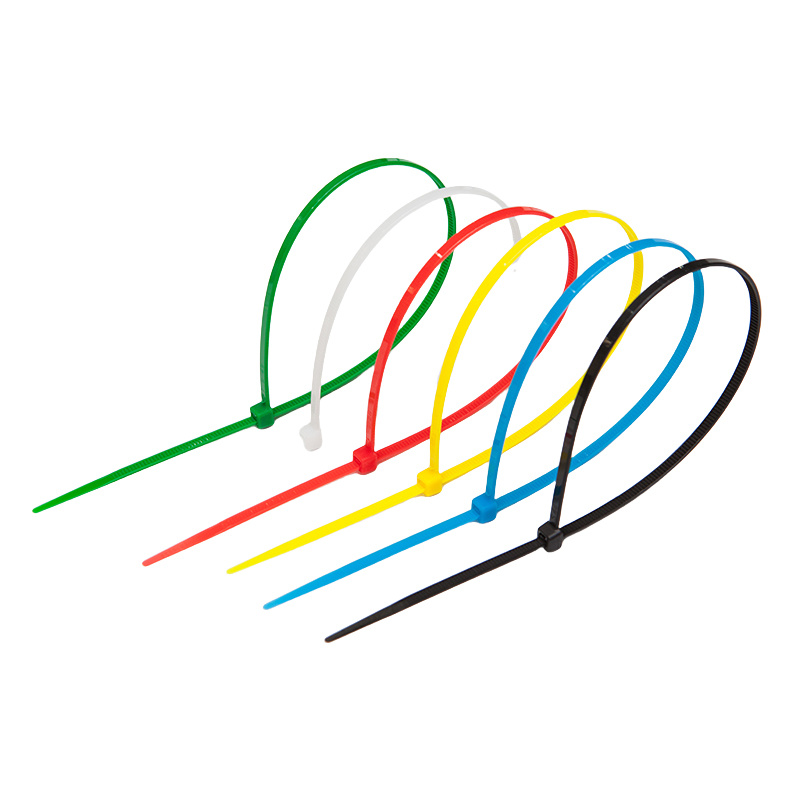 How Are Industrial Nylon Cable Ties Chosen by Rating?
 Industry News Industrial Nylon Cable Ties in a single series can step from 120 LBS to 175 LBS to 250 LBS, and each step suits a different job. In metric terms the three ratin...Read More
-
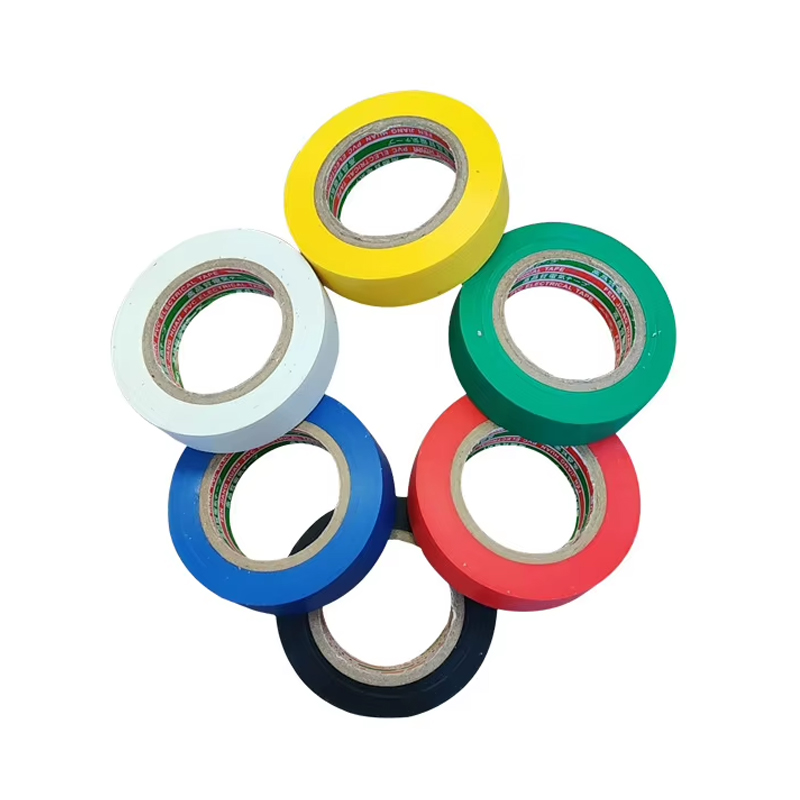 Colored PVC Insulating Tape for Wire Identification and Bundling
Industry News Colored PVC Insulating Tape does two jobs at once. It covers a joint so current stays where it belongs, and it gives that joint a color that tells the next pers...Read More
-
Miniature Nylon Cable Ties: Real Load on Small Bundles
Industry News A bundle of twenty control wires feels heavy in the hand, yet it weighs very little on a cable tie. That is the starting point for choosing Miniature Nylon Cabl...Read More
-
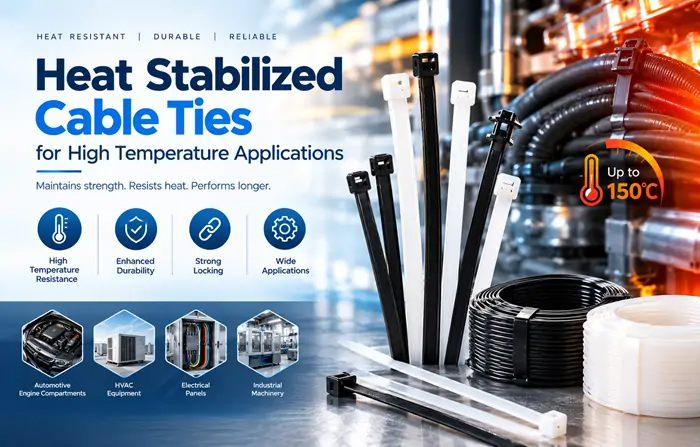 Heat Stabilized Cable Ties for High Temperature Applications
Industry News Heat stabilized cable ties are nylon ties formulated with additives that slow thermal degradation, allowing them to maintain tensile strength and locking perfor...Read More
-
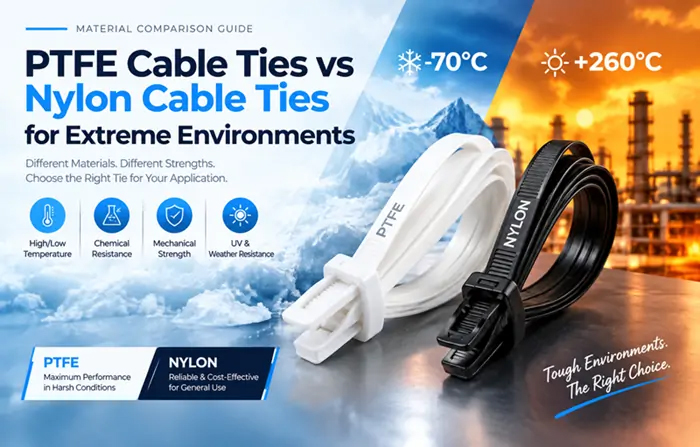 PTFE Cable Ties vs Nylon Cable Ties for Extreme Environments
Industry News PTFE and nylon cable ties serve different ends of the performance spectrum. Nylon cable ties — typically PA66 or PA6 — offer good mechanical strength, moderate ...Read More
-
 Why Nylon Cable Ties Absorb Moisture and How It Affects Performance
Industry News Nylon cable ties absorb moisture because polyamide polymers contain amide groups that attract and bond with water molecules. Standard PA66 absorbs approximately...Read More
-
 PA66 vs PA6 Cable Ties: Material Differences and Selection Guide
Industry News PA66 and PA6 are both nylon polymers used in cable tie manufacturing, but they differ in melting point, moisture absorption, and mechanical performance. PA66 ha...Read More
-
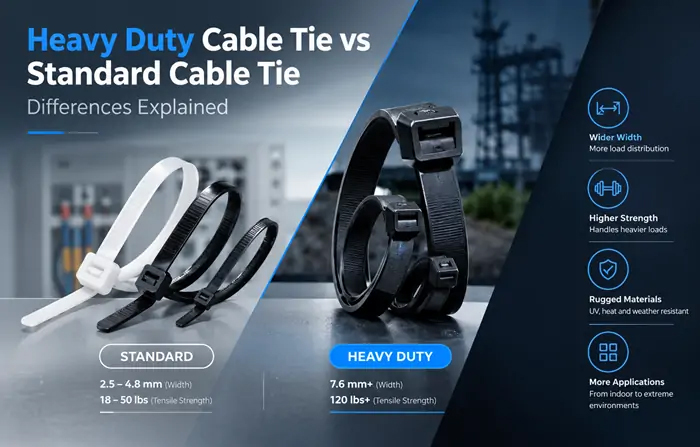 Heavy Duty Cable Tie vs Standard Cable Tie: Differences Explained
Industry News The difference between a standard cable tie and a heavy-duty cable tie comes down to three factors: width, tensile strength, and application. Standard-duty ties...Read More
-
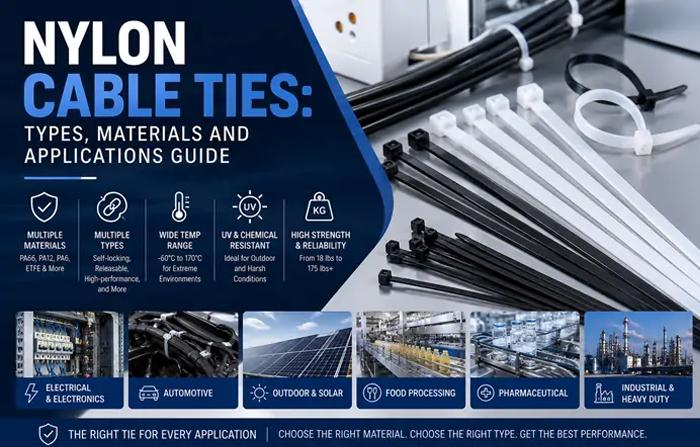 Nylon Cable Ties: Types, Materials and Applications Guide
Industry News Nylon cable ties are available in a wide range of types, materials, and sizes — from 2.5mm miniature ties holding 18 lbs to 7.6mm heavy-duty ties holding 120 lb...Read More
-
 How Much Weight Can Heavy Duty Cable Ties Hold?
Industry News A heavy-duty cable tie's load capacity is determined by its width and material composition. A 7.6mm wide heavy-duty tie typically holds 120 lbs (534 N) of tensi...Read More
-
How Much Weight Can Heavy Duty Cable Ties Hold?
Industry News A heavy-duty cable tie's load capacity is determined by its width and material composition. A 7.6mm wide heavy-duty tie typically holds 120 lbs (534 N) of tensi...Read More
-
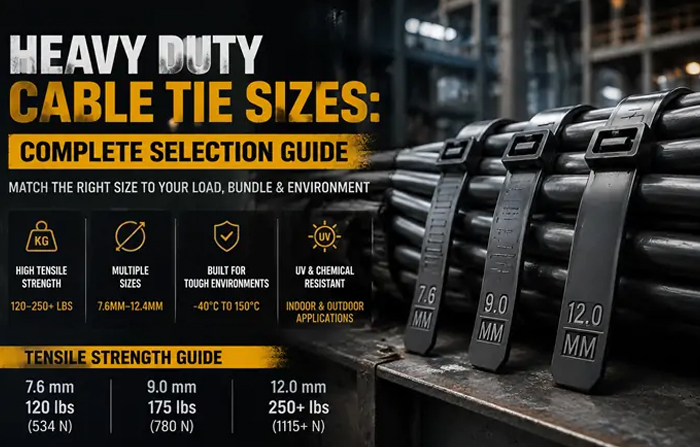 Heavy Duty Cable Tie Sizes: Complete Selection Guide
Industry News Heavy duty cable ties are defined by three core dimensions — length, width, and thickness — and one performance metric: tensile strength. Width is the primary d...Read More
 LET'S CREATE THE FUTURE TOGETHER

Contact Us Anytime
Our Location
No. 57, Yufang Road, Yangming Sub-district, Yuyao City, Ningbo City, Zhejiang Province, China.


Product Categories
Contact Us
Bella Zhou
bella@szsplastic.com
+86-15105741066
lvy Tao
ivy@szsplastic.com
+86-15958801211
Sabrina Yang
sabrina@szsplastic.com
+86-15205749066
Vivian Yang
vivian@szsplastic.com
+86-15158306808
Allen Ju
allen@szsplastic.com
+86-15205748066
Stella Hu
stella@szsplastic.com
+86-15990290008
Dora Liu
dora@szsplastic.com
+86-15990281608
Pepo Lu
pepo@szsplastic.com
+86-15958801191
Copyright © NINGBO SANZHENG PLASTIC CO., LTD. All Rights
Reserved.

Message
We are committed to providing high-quality products and professional services to global customers