


 English
 Español
 русский


Heavy Duty Cable Tie vs Standard Cable Tie: Differences Explained
The difference between a standard cable tie and a heavy-duty cable tie comes down to three factors: width, tensile strength, and application. Standard-duty ties measure 2.5mm to 4.8mm in width with tensile strength of 18 to 50 lbs, while heavy-duty ties start at 7.6mm width with tensile strength of 120 lbs or more. Choosing between them is not about "better" or "worse" — it is about matching the tie to the load, environment, and installation requirements. To see the full range of options available, explore the full product catalog.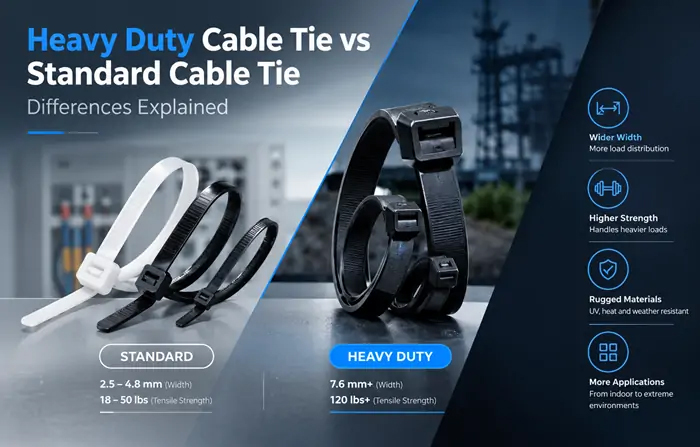
1. What Defines a Cable Tie's Duty Rating?
A cable tie's duty rating — standard, heavy, or ultra-heavy — is primarily determined by its width and tensile strength.
Width is the single most important indicator of a tie's duty class. Wider ties distribute load over a larger area and provide higher tensile strength. The strap thickness also plays a role: heavy-duty ties typically range from 1.0mm to 2.0mm in thickness, compared to thinner standard-duty ties.
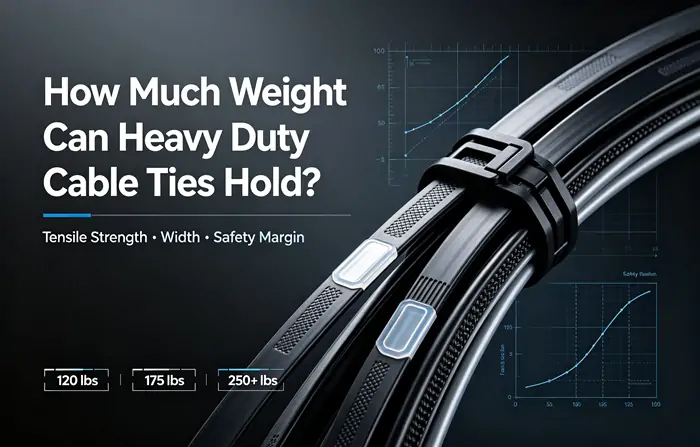
Tensile strength is the maximum pulling force a tie can withstand before failure, measured in pounds (lbs), kilograms (kg), or newtons (N). It is determined by material, width, and thickness.
2. Standard vs Heavy Duty: Side-by-Side Comparison
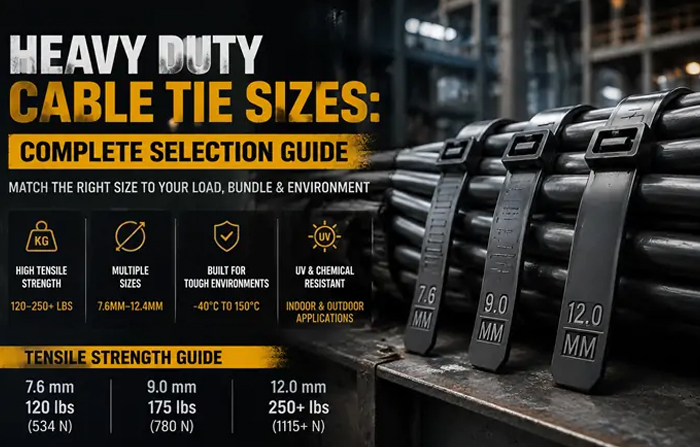
Before diving into the details, review the complete size range for heavy-duty applications.
| Feature | Standard Duty | Heavy Duty | Ultra Heavy Duty |
| Width | 2.5 – 4.8 mm | 7.6 – 8.8 mm | 9.0 – 12.4 mm |
| Tensile Strength | 18 – 50 lbs | 120 – 175 lbs | 175 – 250+ lbs |
| Typical Length Range | 100 – 400 mm | 200 – 920 mm | 300 – 1000+ mm |
| Typical Applications | Light cable runs, panel assembly | Industrial, mining, infrastructure | Large bundles, containment systems, plant rooms |
| Bundle Diameter | Up to ~100 mm | Up to ~225 mm | Up to 300 mm+ |
3. Width: The Primary Differentiator
Width is the most visible and most important difference between standard and heavy-duty cable ties.
Standard-duty ties (2.5 – 4.8 mm)
These are the most common cable ties used in everyday applications. A 4.8mm standard tie is suitable for general electrical installations and light cable runs. They are flexible, easy to install, and cost-effective for high-volume use.
Heavy-duty ties (7.6 – 8.8 mm)
Heavy-duty ties are significantly wider and thicker. The increased width distributes load over a larger area, reducing stress concentration and providing higher tensile strength. They are less flexible than standard ties but far more durable under load.
Ultra-heavy-duty ties (9.0 – 12.4 mm)
At the top of the range, ultra-heavy-duty ties are designed for the most demanding applications — large bundles, containment systems, and plant room installations.
4. Material Considerations
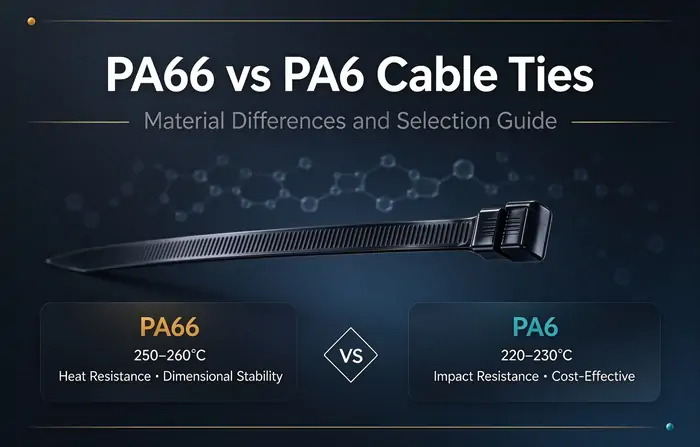
The material composition also differs between standard and heavy-duty cable ties. Standard ties are typically made of PA66 for general-purpose use. Heavy-duty ties often use UV-stabilized PA66 or PA12 for outdoor applications, and heat-stabilized grades for high-temperature environments.
For a deeper understanding of material differences, explore high-performance material options.
5. Applications: Where Each Class Belongs
Standard-duty cable ties are suitable for:
- Light cable runs and wiring in control panels
- General electrical installations
- Indoor applications with minimal environmental stress
- Bundling small to medium cable diameters
- Applications where cost efficiency is a priority
Heavy-duty cable ties are required for:
- Industrial cable management
- Mining and heavy infrastructure projects
- Large cable bundles and heavy conduit
- Applications with vibration or dynamic loads
- Outdoor installations requiring UV resistance
- Safety-critical applications requiring higher load margins
Ultra-heavy-duty cable ties are used for:
- Large bundles and containment systems
- Plant room installations
- Structural securing of heavy equipment
6. Cost Considerations
Heavy-duty cable ties cost more than standard ties due to:
- More material: Wider and thicker ties use more nylon per unit
- Higher-grade material: Heavy-duty applications often require UV-stabilized or heat-stabilized formulations
- Tighter quality control: Higher tensile strength requirements demand more rigorous testing
However, specifying heavy-duty ties where standard ties would suffice adds unnecessary cost. The key is to match the tie to the actual requirements — not the perceived "safety" of a larger size.
If you are unsure which duty class fits your project, consult the technical team for guidance.
7. When to Choose Standard vs Heavy Duty
Choose standard duty when:
- Bundle diameter is under 100mm
- Load requirements are under 50 lbs
- Application is indoors with no UV or extreme temperature exposure
- Cost is a primary concern
- Installation requires flexibility and ease of handling
Choose heavy duty when:
- Bundle diameter exceeds 100mm
- Load requirements exceed 50 lbs
- Application involves vibration, movement, or dynamic loads
- Installation is outdoors or in harsh environments
- Safety margins are critical
- Long-term reliability is required
8. Common Mistakes to Avoid
Mistake 1: Choosing based on length alone
Length determines bundle capacity, not strength. A longer standard tie does not become a heavy-duty tie — width and tensile strength are what matter.
Mistake 2: Overspecifying for perceived safety
Heavy-duty ties cost more and are less flexible. Using them where standard ties would suffice adds unnecessary cost and makes installation more difficult.
Mistake 3: Underspecifying for cost savings
Using standard ties in heavy-duty applications risks bundle failure, rework, and safety incidents. The cost of failure almost always exceeds the cost of upgrading.
Mistake 4: Ignoring environmental factors
A standard tie used outdoors without UV stabilization will degrade rapidly. Even if the load is light, UV exposure alone may justify upgrading to a UV-stabilized heavy-duty tie.
FAQ
Q: What is the main difference between standard and heavy-duty cable ties?
The main differences are width and tensile strength. Standard ties measure 2.5–4.8mm wide with 18–50 lbs strength, while heavy-duty ties start at 7.6mm wide with 120+ lbs strength.
Q: When should I use a heavy-duty cable tie instead of a standard one?
Use heavy-duty ties when bundle diameter exceeds 100mm, load exceeds 50 lbs, or the application involves vibration, outdoor exposure, or safety-critical requirements.
Q: Are heavy-duty cable ties stronger than standard ties of the same length?
Yes. Strength is determined by width and thickness, not length. A shorter heavy-duty tie is stronger than a longer standard tie.
Q: Can I use standard cable ties outdoors?
Standard nylon ties without UV stabilization will degrade under prolonged sunlight exposure. For outdoor use, select UV-stabilized or PA12 materials, which are typically available in heavy-duty grades.
Q: Do heavy-duty cable ties cost more than standard ties?
Yes. Heavy-duty ties use more material and often require higher-grade formulations, making them more expensive. However, the additional cost is justified in applications where standard ties would fail.
Q: How do I know if I need standard or heavy-duty?
Measure your bundle diameter, estimate your load requirements, and assess your environmental conditions. If any factor exceeds standard-duty capabilities, upgrade to heavy-duty.
Conclusion
The choice between standard and heavy-duty cable ties is not about quality — it is about matching the tie to the application. Standard ties (2.5–4.8mm, 18–50 lbs) are cost-effective solutions for light cable runs, panel assembly, and indoor applications. Heavy-duty ties (7.6mm+, 120+ lbs) are required for industrial, mining, infrastructure, and outdoor applications where higher load capacity and durability are essential.
The most common mistake is choosing based on length alone while ignoring width, tensile strength, and environmental factors. A tie that is long enough but too narrow will fail under load. A tie with adequate tensile strength but no UV stabilization will fail outdoors.
To build a broader understanding of cable tie fundamentals, explore our guide on nylon cable tie types, materials, and applications.
For a complete overview of available standard and heavy-duty cable tie configurations, review the full product catalog. If your application has specific load, temperature, or environmental requirements, consult the technical team for material recommendations.
Disclaimer: The technical information, tensile strength values, and comparison data presented in this article are compiled from industry-standard references and general engineering knowledge for general informational purposes only. Actual product performance may vary depending on manufacturing processes, material formulations, installation methods, and specific application conditions. Buyers are strongly encouraged to consult the technical team to confirm product specifications for their specific use cases.
NEXT:PA66 vs PA6 Cable Ties: Material Differences and Selection Guide
Interested in cooperation or have questions?
-
 View MoreMiniature Nylon Cable Ties 18 LBS
-
 View MoreIntermediate Nylon Cable Ties 40 LBS
-
 View MoreStandard Nylon Cable Ties 50 LBS
-
View MoreHeavy Duty Nylon Cable Ties 120 175 250 LBS
-
 View MoreBulk Cable Tie Value Pack
-
 View MoreReusable Releasable Cable Ties
-
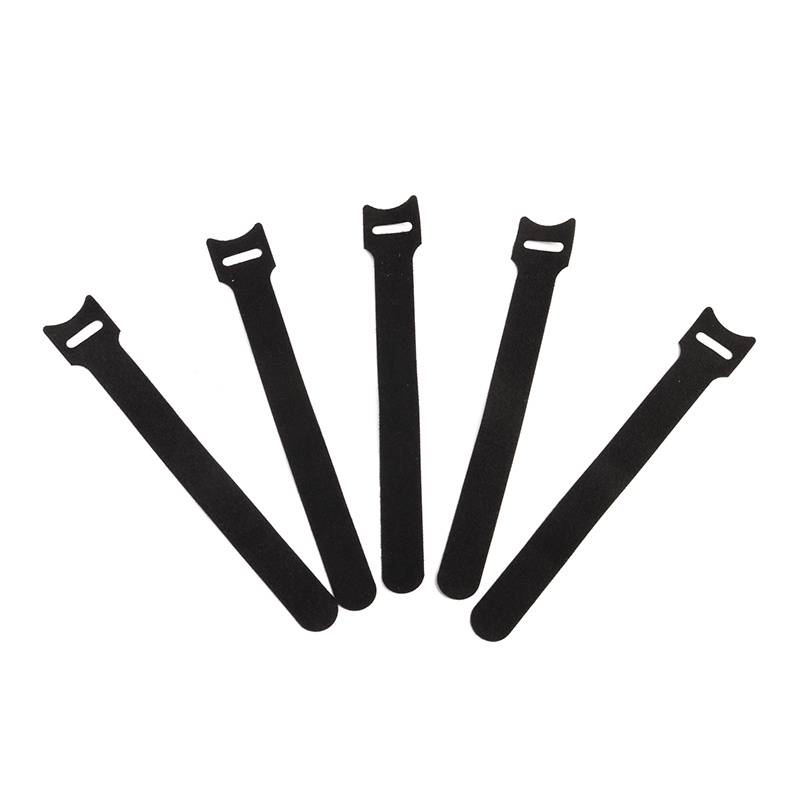 View MoreMagic Reusable Cable Ties
-
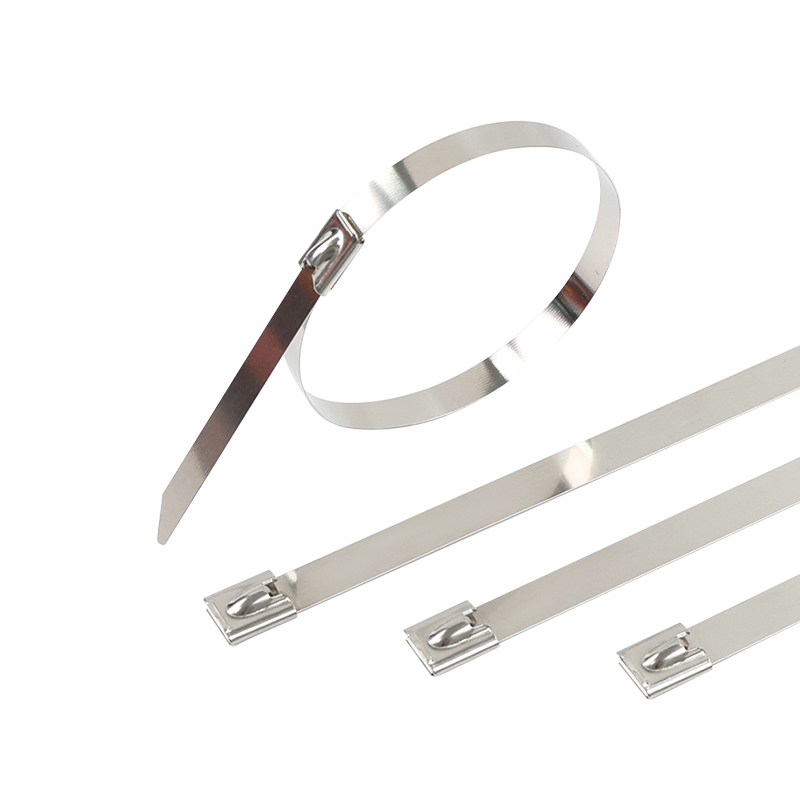 View MoreStainless Steel Self Locking Cable Ties
-
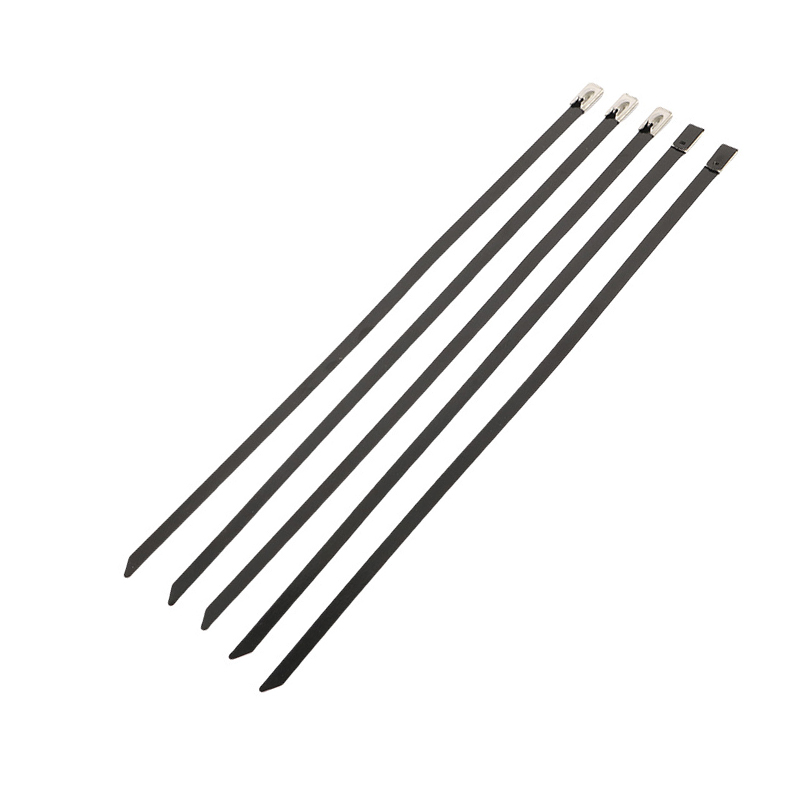 View MorePVC Coated Stainless Steel Cable Ties
-
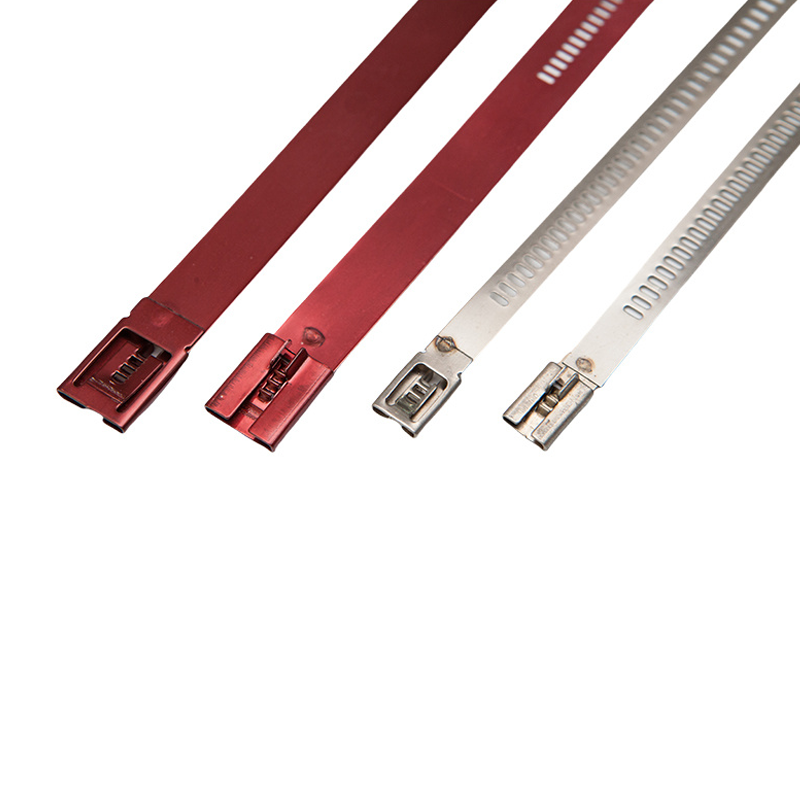 View MoreMulti Lock Stainless Steel Cable Ties
-
 View MoreStainless Steel Hose Clamps
-
 View MoreStainless Steel Cable Tie Markers
 LET'S CREATE THE FUTURE TOGETHER

Contact Us Anytime
Our Location
No. 57, Yufang Road, Yangming Sub-district, Yuyao City, Ningbo City, Zhejiang Province, China.


Product Categories
Contact Us
bella@szsplastic.com
+86-15105741066
ivy@szsplastic.com
+86-15958801211
sabrina@szsplastic.com
+86-15205749066
vivian@szsplastic.com
+86-15158306808
allen@szsplastic.com
+86-15205748066
stella@szsplastic.com
+86-15990290008
dora@szsplastic.com
+86-15990281608
pepo@szsplastic.com
+86-15958801191
Copyright © NINGBO SANZHENG PLASTIC CO., LTD. All Rights
Reserved.
