


 English
 Español
 русский


PA66 vs PA6 Cable Ties: Material Differences and Selection Guide
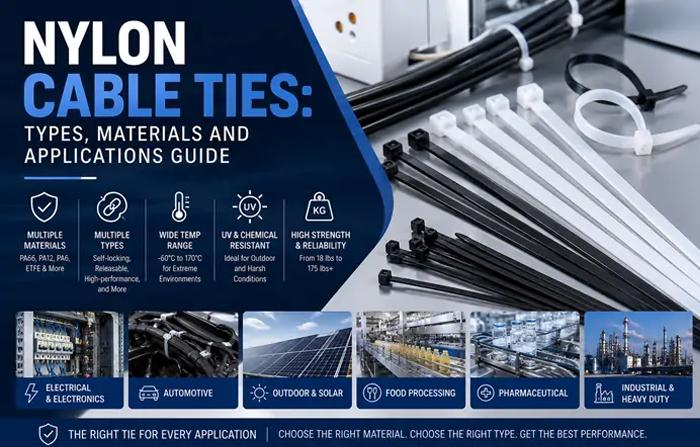
PA66 and PA6 are both nylon polymers used in cable tie manufacturing, but they differ in melting point, moisture absorption, and mechanical performance. PA66 has a higher melting point (250–260°C) and lower moisture absorption (2.5%) compared to PA6 (220–230°C, 3.5%). These differences affect heat resistance, dimensional stability, and impact behavior in real applications. This guide compares PA66 and PA6 cable ties across key properties — including thermal performance, moisture behavior, mechanical strength, chemical resistance, and processing characteristics — to help buyers select the right material for their specific application. To see the full range of nylon cable ties available, explore the full nylon cable tie range.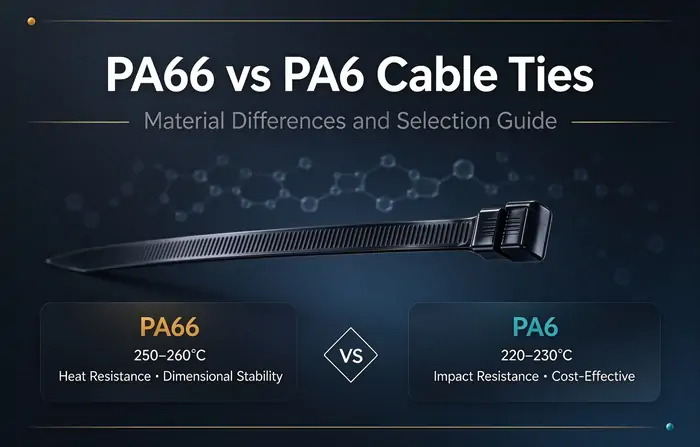
1. What Is PA66 and PA6?
PA66 (Nylon 6.6) and PA6 (Nylon 6) are both polyamide polymers, but their molecular structures differ. PA66 is made from hexamethylenediamine and adipic acid, while PA6 is made from caprolactam. This structural difference affects their melting points, moisture absorption, and mechanical properties.
Both materials are widely used in cable ties, but they are not interchangeable in every application. Understanding the differences helps buyers select the right grade for their specific requirements.
PA66 was first developed by DuPont in the 1930s and is known for its high strength, rigidity, and heat resistance. It is widely used in automotive, industrial, and electrical applications.
PA6 was developed slightly later and is known for its toughness, impact resistance, and flexibility. It is widely used in general-purpose cable management, consumer goods, and applications where impact resistance is more important than maximum rigidity.
Both materials are hygroscopic — they absorb moisture from the environment — but the degree of absorption differs, which affects dimensional stability and mechanical performance.
2. PA66 vs PA6: Property Comparison
| Property | PA66 | PA6 |
| Melting Point | 250–260°C | 220–230°C |
| Operating Temperature | -40 to +85°C (modified: -60 to +150°C) | -40 to +80°C |
| Water Absorption | 2.50% | 3.50% |
| Tensile Strength | Higher | Good |
| Impact Resistance | Good | Higher |
| Rigidity | Higher | Lower |
| Dimensional Stability | Better | Moderate |
| Heat Resistance | Better | Moderate |
| Chemical Resistance | Good | Good |
| Abrasion Resistance | Higher | Good |
| Cost | Higher | Lower |
| Processing Temperature | Higher | Lower |
3. Melting Point and Heat Resistance
PA66 has a higher melting point (250–260°C) than PA6 (220–230°C). This difference translates directly to heat resistance in cable tie applications. PA66 cable ties can operate continuously at higher temperatures and are often the preferred choice for under-hood automotive applications, industrial equipment, and electrical panels where heat exposure is a concern.
What this means in practice:
- PA66 cable ties can withstand continuous operating temperatures up to 85°C, with modified grades extending to 150°C. They retain tensile strength and dimensional stability at elevated temperatures.
- PA6 cable ties have a lower melting point and are generally suitable for applications where heat exposure is moderate. They may soften or lose tensile strength at temperatures that PA66 can withstand.
Modified PA66 grades — often referred to as heat-stabilized grades — can extend the operating temperature range to -60°C to +150°C, making them suitable for extreme environments. These formulations are used in aerospace, automotive, and industrial applications requiring high-temperature stability.
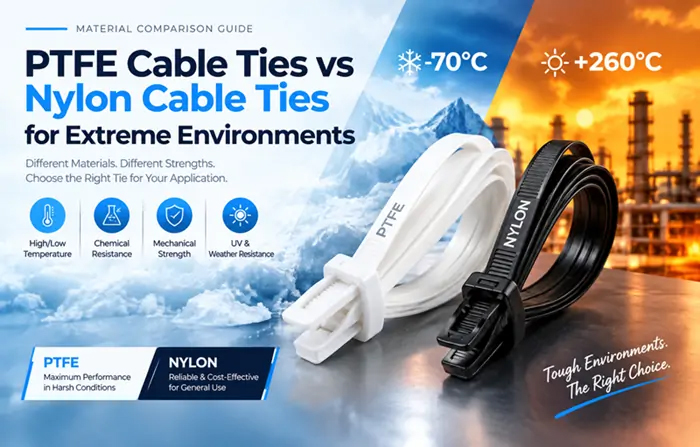
For applications requiring heat resistance beyond standard PA66, alternative materials such as ETFE or PEEK may be considered. To explore options, review high-performance material options.
4. Moisture Absorption and Dimensional Stability
PA66 absorbs approximately 2.5% moisture at equilibrium, while PA6 absorbs approximately 3.5%. This difference affects dimensional stability — the ability of the material to maintain its shape and mechanical properties when exposed to humidity.
Why moisture absorption matters:
- When nylon absorbs moisture, it swells. This swelling can affect the locking mechanism of a cable tie, potentially reducing holding strength or causing the tie to loosen over time.
- Moisture absorption also affects tensile strength. In humid environments, PA6 cable ties may lose more strength than PA66 ties.
- Dimensional changes can affect the fit of the tie in mounting holes or cable trays.
PA66 maintains better dimensional stability in humid environments, making it more suitable for applications where moisture exposure is a factor — such as outdoor installations, marine environments, or food processing facilities.
PA6 absorbs more moisture and may swell more in humid conditions, which can affect performance in precision applications.
For applications requiring the lowest moisture absorption, PA12 is an alternative with only 0.75% water absorption. To compare material options, review high-performance material options.
5. Mechanical Properties: Strength vs Impact Resistance
PA66 offers higher tensile strength and rigidity compared to PA6. This makes PA66 cable ties suitable for applications requiring high load capacity and minimal stretch under tension.
PA66 mechanical profile:
- Higher tensile strength — suitable for load-bearing applications
- Higher rigidity — maintains shape under load
- Better creep resistance — resists gradual deformation under sustained load
- Higher abrasion resistance — suitable for applications with movement or vibration
PA6 mechanical profile:
- Higher impact resistance — resists sudden impacts without cracking
- Higher toughness — absorbs energy better
- Greater flexibility — easier to install in tight spaces
- Better resistance to repeated bending
The choice between strength and impact resistance depends on the application. Static loads favor PA66; dynamic loads or applications involving vibration may favor PA6.
Creep resistance is an often-overlooked factor. Creep is the tendency of a material to deform slowly under sustained load. PA66 has better creep resistance than PA6, meaning it maintains its clamping force better over time in load-bearing applications.
6. Applications: Where Each Material Fits
PA66 cable ties are commonly used in:
- Automotive under-hood applications — engine compartments, wiring harnesses, fluid lines
- Industrial equipment and machinery — where heat and load are factors
- Electrical panels and control cabinets — where heat buildup is a concern
- High-temperature environments — near engines, furnaces, or industrial processes
- Applications requiring high tensile strength — heavy cable bundles, structural securing
- Applications where dimensional stability is critical — precision installations, humid environments
PA6 cable ties are commonly used in:
- General cable management — office wiring, home electronics, light-duty bundling
- Applications requiring impact resistance — moving equipment, vibration-prone installations
- Indoor installations with moderate temperatures — climate-controlled environments
- Cost-sensitive projects — where performance requirements are moderate
- Applications where flexibility is important — tight spaces, complex routing
For a complete overview of available configurations, view the complete product range.
7. Chemical Resistance Comparison
Both PA66 and PA6 offer good resistance to common chemicals, but there are differences:
| Chemical | PA66 Resistance | PA6 Resistance |
| Oils and Greases | Good | Good |
| Fuels | Moderate | Moderate |
| Weak Acids | Moderate | Moderate |
| Strong Acids | Poor | Poor |
| Weak Bases | Good | Good |
| Strong Bases | Poor | Poor |
| Alcohols | Good | Good |
| Ketones | Poor | Poor |
| Chlorinated Solvents | Poor | Poor |
Both materials are susceptible to attack by strong acids, strong bases, and certain solvents. For applications involving chemical exposure, alternative materials such as ETFE or PVDF may be required.
8. Processing and Manufacturing Differences
PA66 and PA6 also differ in their processing characteristics, which can affect manufacturing cost and product consistency:
| Processing Factor | PA66 | PA6 |
| Melting Temperature | Higher (250–260°C) | Lower (220–230°C) |
| Mold Temperature | Higher | Lower |
| Processing Window | Narrower | Wider |
| Moisture Sensitivity | Higher | Higher |
| Shrinkage | Higher | Lower |
| Cycle Time | Longer | Shorter |
PA66 requires higher processing temperatures and more precise control, which can increase manufacturing cost. However, the resulting product offers better heat resistance and dimensional stability.
PA6 processes at lower temperatures and has a wider processing window, which can reduce manufacturing cost. It also has lower shrinkage, which can improve dimensional consistency.
Both materials require drying before processing to prevent moisture-related defects such as bubbles or weak spots.
9. How to Choose Between PA66 and PA6
When selecting between PA66 and PA6 cable ties, consider these factors:
Temperature: If the application involves continuous heat exposure above 80°C, PA66 is the better choice. PA6 may soften or lose strength. For temperatures above 150°C, consider heat-stabilized PA66 or alternative materials.
Moisture: If the application is in a humid environment, PA66 offers better dimensional stability. PA6 absorbs more moisture and may swell. For extremely humid environments, PA12 offers even lower moisture absorption.
Load: If maximum tensile strength is required, PA66 is the better option. PA6 offers good strength but slightly lower than PA66. For load-bearing applications, consider the creep resistance of PA66.
Impact: If the application involves vibration or sudden impacts, PA6 offers better toughness and impact resistance.
Chemical Exposure: Both materials offer similar chemical resistance. For aggressive chemical environments, consider ETFE or other high-performance materials.
Cost: PA6 is generally more cost-effective than PA66. For cost-sensitive projects with moderate performance requirements, PA6 may be sufficient.
Certification: Check if UL, RoHS, REACH, or industry-specific certifications are required. Both PA66 and PA6 are available in compliant grades.
If you are unsure which material fits your project, consult the technical team for guidance.
10. Common Mistakes to Avoid
Mistake 1: Assuming PA66 and PA6 are interchangeable
While both are nylons, their properties differ. PA66 offers better heat resistance and dimensional stability; PA6 offers better impact resistance. Selecting the wrong grade can lead to premature failure.
Mistake 2: Ignoring moisture absorption
In humid environments, PA6 may absorb enough moisture to affect performance. PA66 offers better dimensional stability. For critical applications, consider PA12.
Mistake 3: Choosing based on cost alone
PA6 is less expensive, but if the application requires high heat resistance or dimensional stability, PA66 is the better investment. The cost of failure — rework, downtime, safety incidents — often exceeds the cost difference.
Mistake 4: Overlooking temperature limits
PA6 has a lower melting point and operating temperature range than PA66. Using PA6 in high-temperature applications may cause softening or failure.
Mistake 5: Ignoring creep in load-bearing applications
PA66 has better creep resistance than PA6. In applications where the tie must maintain clamping force over years, PA66 is the better choice.
Mistake 6: Overlooking UV exposure
Neither PA66 nor PA6 is inherently UV-resistant. For outdoor applications, UV-stabilized grades or PA12 should be used.
11. Testing and Verification
When selecting cable ties for critical applications, consider these verification steps:
- Tensile strength testing: Verify the rated tensile strength at the expected operating temperature.
- Heat ageing testing: Verify performance after prolonged exposure to operating temperature.
- Moisture conditioning: Verify performance after exposure to humidity.
- UV exposure testing: For outdoor applications, verify UV resistance.
- Chemical compatibility testing: For chemical exposure, verify resistance to specific chemicals.
- Creep testing: For load-bearing applications, verify long-term deformation behavior.
Suppliers who can provide test data for these parameters offer a more reliable basis for selection than datasheet values alone.
12. Industry-Specific Considerations
Automotive: PA66 is preferred for under-hood applications due to its higher heat resistance. PA6 may be used in interior applications.
Electrical: PA66 is preferred for panels and control cabinets where heat buildup is a concern. PA6 may be used for general wiring.
Outdoor: UV-stabilized PA66 or PA12 is preferred. Standard PA6 may degrade faster under UV exposure.
Food Processing: Metal detectable grades are available in both PA66 and PA6. Consider moisture absorption and cleanability.
Marine: PA12 is preferred for its low moisture absorption and UV resistance. PA66 may be used with UV stabilization.
Aerospace: Heat-stabilized PA66 is commonly used. PA6 may be used in non-critical applications.
FAQ
Q: What is the main difference between PA66 and PA6 cable ties?
PA66 has a higher melting point (250–260°C) and lower moisture absorption (2.5%) compared to PA6 (220–230°C, 3.5%). PA66 offers better heat resistance and dimensional stability; PA6 offers better impact resistance.
Q: Which is stronger, PA66 or PA6 cable ties?
PA66 offers higher tensile strength and rigidity. PA6 offers higher impact resistance and toughness. The "stronger" material depends on whether the application requires static load capacity or impact resistance.
Q: Can PA6 cable ties be used outdoors?
PA6 cable ties can be used outdoors, but they absorb more moisture than PA66 and may have lower dimensional stability in humid conditions. For outdoor applications, PA12 or UV-stabilized materials are often preferred.
Q: Are PA66 cable ties more expensive than PA6?
Yes, PA66 is generally more expensive than PA6 due to higher raw material costs and processing requirements. However, the performance benefits may justify the cost in demanding applications.
Q: What temperature can PA66 and PA6 cable ties withstand?
PA66 cable ties operate from -40°C to +85°C, with modified grades extending to -60°C to +150°C. PA6 cable ties typically operate from -40°C to +80°C.
Q: Which material is better for automotive applications?
PA66 is commonly used in automotive under-hood applications due to its higher heat resistance and dimensional stability. PA6 may be used in interior applications where impact resistance is more important.
Q: Can PA66 and PA6 cable ties be recycled?
Both PA66 and PA6 are thermoplastics and can be recycled. However, recycling rates for cable ties are generally low due to their small size and the difficulty of collection.
Q: How does moisture affect cable tie performance?
Moisture absorption causes nylon to swell, which can affect the locking mechanism and tensile strength. PA66 absorbs less moisture than PA6, making it more dimensionally stable in humid environments.
Q: What is creep and why does it matter?
Creep is the tendency of a material to deform slowly under sustained load. PA66 has better creep resistance than PA6, meaning it maintains clamping force better over time in load-bearing applications.
Q: Are there other nylon grades used in cable ties?
Yes. PA12 offers lower moisture absorption (0.75%) and better UV resistance. PA11 offers similar properties with different processing characteristics. PA66 and PA6 are the most common, but specialty grades are available for specific applications.
Q: How do I verify the performance of a cable tie for my application?
Request test data from the supplier, including tensile strength at operating temperature, heat ageing performance, moisture conditioning results, and UV exposure data. For critical applications, consider independent testing.
Q: What certifications should I look for?
Common certifications include UL, RoHS, REACH, and ISO 9001. Industry-specific certifications may apply for automotive, aerospace, food processing, or medical applications.
Conclusion
PA66 and PA6 cable ties offer different performance characteristics. PA66 provides higher heat resistance, better dimensional stability, and higher tensile strength. PA6 offers better impact resistance and is more cost-effective. The choice depends on the application requirements — temperature, moisture exposure, load, impact conditions, and chemical exposure.
Key selection criteria:
- Temperature: PA66 for continuous exposure above 80°C; PA6 for moderate temperatures
- Moisture: PA66 for humid environments; PA12 for extremely humid or outdoor environments
- Load: PA66 for high load and creep resistance; PA6 for moderate loads
- Impact: PA6 for vibration and impact; PA66 for static loads
- Cost: PA6 for cost-sensitive projects; PA66 for demanding applications
The most common mistake is assuming all nylon cable ties are the same. Material selection affects long-term performance and reliability. For high-temperature or humid environments, PA66 is the better choice. For applications requiring impact resistance and cost efficiency, PA6 may be sufficient.
To build a broader understanding of cable tie materials, explore our guide on nylon cable tie types, materials, and applications.
Disclaimer: The material data and property comparisons presented in this article are compiled from industry-standard references and general polymer science knowledge for general informational purposes only. Actual product performance may vary depending on manufacturing processes, material formulations, and specific application conditions. Buyers are strongly encouraged to consult the technical team to confirm product specifications for their specific use cases.
NEXT:Why Nylon Cable Ties Absorb Moisture and How It Affects Performance
Interested in cooperation or have questions?
-
 View MoreMiniature Nylon Cable Ties 18 LBS
-
 View MoreIntermediate Nylon Cable Ties 40 LBS
-
 View MoreStandard Nylon Cable Ties 50 LBS
-
View MoreHeavy Duty Nylon Cable Ties 120 175 250 LBS
-
 View MoreBulk Cable Tie Value Pack
-
 View MoreReusable Releasable Cable Ties
-
 View MoreMagic Reusable Cable Ties
-
 View MoreStainless Steel Self Locking Cable Ties
-
 View MorePVC Coated Stainless Steel Cable Ties
-
 View MoreMulti Lock Stainless Steel Cable Ties
-
 View MoreStainless Steel Hose Clamps
-
 View MoreStainless Steel Cable Tie Markers
 LET'S CREATE THE FUTURE TOGETHER

Contact Us Anytime
Our Location
No. 57, Yufang Road, Yangming Sub-district, Yuyao City, Ningbo City, Zhejiang Province, China.


Product Categories
Contact Us
bella@szsplastic.com
+86-15105741066
ivy@szsplastic.com
+86-15958801211
sabrina@szsplastic.com
+86-15205749066
vivian@szsplastic.com
+86-15158306808
allen@szsplastic.com
+86-15205748066
stella@szsplastic.com
+86-15990290008
dora@szsplastic.com
+86-15990281608
pepo@szsplastic.com
+86-15958801191
Copyright © NINGBO SANZHENG PLASTIC CO., LTD. All Rights
Reserved.
