


 English
 Español
 русский


PTFE Cable Ties vs Nylon Cable Ties for Extreme Environments
PTFE and nylon cable ties serve different ends of the performance spectrum. Nylon cable ties — typically PA66 or PA6 — offer good mechanical strength, moderate temperature resistance, and low cost for general-purpose applications. PTFE cable ties offer exceptional chemical resistance, a wider operating temperature range, and near-zero moisture absorption, but at significantly higher cost and lower tensile strength. The choice depends on whether the application demands extreme chemical or thermal performance that nylon cannot deliver. This guide compares PTFE and nylon cable ties across key performance dimensions to help buyers determine which material fits their environment. To see the full range of nylon cable ties available, explore the full nylon cable tie range.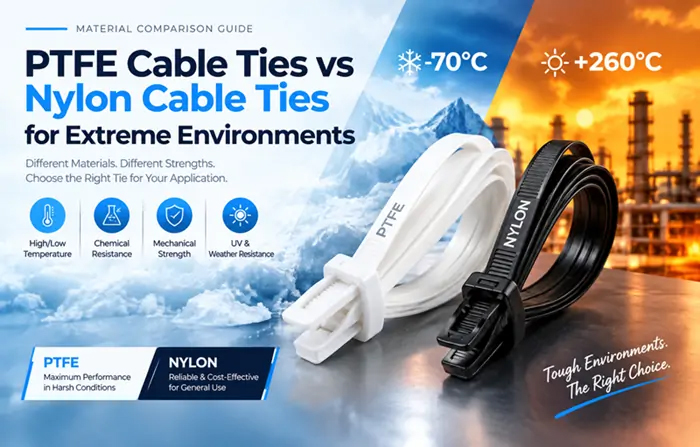
1. What Is PTFE and Why Is It Used in Cable Ties?
PTFE (polytetrafluoroethylene) is a fluoropolymer made of carbon and fluorine atoms. The carbon-fluorine bond is one of the strongest in organic chemistry, which gives PTFE its exceptional chemical inertness and thermal stability. PTFE is commonly known by the brand name Teflon.
PTFE cable ties are used in applications where standard nylon ties would fail — such as chemical processing plants, semiconductor manufacturing, pharmaceutical production, and high-temperature industrial processes. The material's inertness means it does not react with most chemicals, and its thermal stability allows it to operate at temperatures that would melt or degrade nylon.
However, PTFE also has limitations. It has lower tensile strength than nylon, it is significantly more expensive, and it is softer, which can affect locking mechanism performance in high-load applications.
2. PTFE vs Nylon: Property Comparison
| Property | PTFE | Nylon (PA66) | Nylon (PA6) |
| Operating Temperature | -70 to +260°C | -40 to +85°C (modified: -60 to +150°C) | -40 to +80°C |
| Chemical Resistance | Excellent | Moderate | Moderate |
| Water Absorption | < 0.01% | 2.50% | 3.50% |
| Tensile Strength | Lower | Higher | Good |
| Flexibility | Moderate | Good | Higher |
| UV Resistance | Excellent | Poor (requires stabilization) | Poor (requires stabilization) |
| Abrasion Resistance | Lower | Good | Good |
| Cost | Significantly higher | Lower | Lower |
| Flammability | UL94 V-0 | UL94 V-2 (standard) | UL94 V-2 (standard) |
| Dielectric Strength | Excellent | Good | Good |
3. Temperature Performance: Where PTFE Excels
PTFE cable ties operate from -70°C to +260°C — a range that far exceeds the capabilities of standard nylon. This makes PTFE suitable for applications involving:
- High-temperature industrial processes (furnaces, ovens, heat exchangers)
- Cryogenic environments (liquid nitrogen, cold chain at extreme temperatures)
- Aerospace and defense systems
- Semiconductor manufacturing equipment
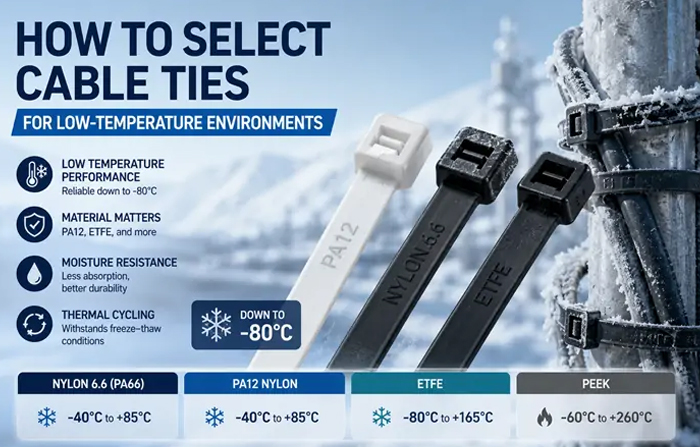
Nylon cable ties — even heat-stabilized grades — have a lower operating ceiling. Standard PA66 operates from -40°C to +85°C. Modified heat-stabilized grades extend this to -60°C to +150°C, but still fall short of PTFE's upper limit.
For applications that fluctuate between extreme hot and cold, PTFE maintains consistent mechanical properties across the entire range. Nylon may become brittle at the low end or soften at the high end, depending on the formulation.
To compare how different nylon grades handle temperature extremes, compare PA66 and PA6 material properties.
4. Chemical Resistance: PTFE's Core Advantage
PTFE is chemically inert to virtually all industrial chemicals, including:
- Strong acids (sulfuric, nitric, hydrochloric)
- Strong bases (sodium hydroxide, potassium hydroxide)
- Solvents (acetone, benzene, toluene)
- Fuels and oils
- Oxidizers
Nylon, by contrast, has moderate chemical resistance. It resists weak acids, weak bases, alcohols, and oils, but is attacked by strong acids, strong bases, and certain solvents. In chemical processing environments, nylon cable ties may degrade, swell, or lose strength over time.
For applications involving chemical exposure, PTFE cable ties offer a level of resistance that nylon cannot match. The table below summarizes the difference:
| Chemical | PTFE Resistance | Nylon (PA66) Resistance |
| Strong Acids | Excellent | Poor |
| Strong Bases | Excellent | Poor |
| Solvents | Excellent | Poor to Moderate |
| Fuels and Oils | Excellent | Good |
| Alcohols | Excellent | Good |
| Oxidizers | Excellent | Poor |
5. Mechanical Strength: Where Nylon Wins
Nylon cable ties offer higher tensile strength than PTFE ties. A standard 7.6mm wide PA66 cable tie typically delivers 120 lbs of tensile strength. A comparable PTFE tie may deliver significantly less — often 50 lbs or lower — due to PTFE's lower mechanical strength.
This difference matters in load-bearing applications. For securing heavy cable bundles, structural components, or equipment that experiences vibration, nylon ties offer better holding capability.
PTFE ties are generally used in applications where chemical or thermal resistance is the primary requirement, and mechanical load is secondary.
6. Water Absorption and Dimensional Stability
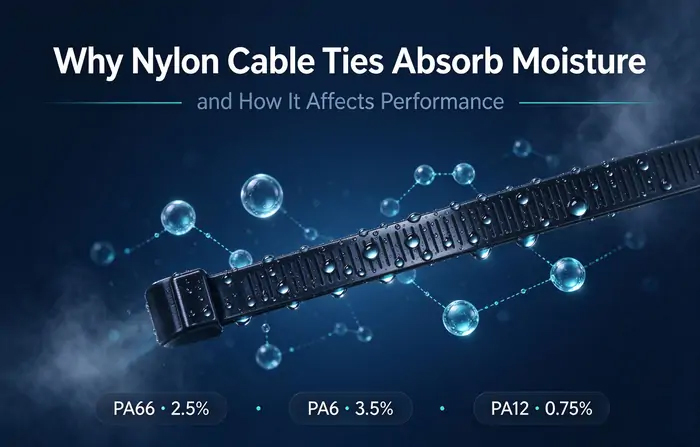
Nylon absorbs moisture — PA66 absorbs approximately 2.5% at equilibrium, and PA6 absorbs approximately 3.5%. This absorption causes dimensional changes that can affect locking mechanism performance and fit in mounting holes.
PTFE absorbs virtually no moisture — less than 0.01%. This makes PTFE ties dimensionally stable in humid, wet, or submerged environments. For applications where dimensional precision is critical, PTFE offers an advantage.
For applications requiring low moisture absorption but higher mechanical strength than PTFE, PA12 offers a middle ground with approximately 0.75% moisture absorption. To compare options, explore high-performance material options.
7. UV Resistance and Outdoor Performance
PTFE is inherently UV-resistant. It does not degrade under prolonged sunlight exposure, making it suitable for outdoor applications without additional stabilization.
Nylon — both PA66 and PA6 — degrades under UV exposure unless stabilized. Standard nylon cable ties used outdoors may become brittle and fail within 6 to 18 months. UV-stabilized grades extend this, but still require consideration of UV exposure in outdoor specifications.
For outdoor applications in harsh chemical or high-temperature environments, PTFE offers both UV resistance and chemical resistance in a single material.
8. Cost Considerations
PTFE cable ties cost significantly more than nylon ties. The price difference reflects:
- Higher raw material cost — PTFE is more expensive to produce than nylon
- More complex processing — PTFE has a higher melting point and requires specialized equipment
- Lower production volumes — PTFE ties are specialty products, not mass-produced
For cost-sensitive projects where nylon meets the performance requirements, nylon is the better choice. PTFE is justified only when the application demands chemical or thermal performance that nylon cannot deliver.
9. When to Choose PTFE vs Nylon
| Application Requirement | Recommended Material |
| General cable management, indoor | Nylon (PA66 or PA6) |
| Outdoor, UV exposure | UV-stabilized nylon or PA12 |
| High temperature (up to 150°C) | Heat-stabilized nylon |
| Extreme temperature (up to 260°C) | PTFE |
| Chemical exposure (strong acids/bases) | PTFE |
| Chemical exposure (weak acids/bases) | Nylon (PA66) |
| High mechanical load | Nylon |
| Low mechanical load, chemical resistance | PTFE |
| Moisture-critical application | PTFE or PA12 |
| Cost-sensitive application | Nylon |
10. Common Mistakes to Avoid
Mistake 1: Assuming PTFE is always better
PTFE offers superior chemical and thermal resistance, but lower mechanical strength and higher cost. For applications where nylon meets the requirements, nylon is the more economical choice.
Mistake 2: Using nylon in strong chemical environments
Nylon degrades under exposure to strong acids, bases, and certain solvents. In chemical processing environments, PTFE or other high-performance materials are required.
Mistake 3: Overlooking temperature limits
Standard nylon ties have a lower temperature ceiling than PTFE. Using nylon in high-temperature applications may cause softening, deformation, or failure.
Mistake 4: Ignoring mechanical load requirements
PTFE ties have lower tensile strength than nylon. For load-bearing applications, nylon is the better choice unless the environment requires PTFE's chemical or thermal resistance.
Mistake 5: Assuming all "Teflon" ties are PTFE
Some products marketed as "Teflon cable ties" may use ETFE or other fluoropolymers rather than pure PTFE. These materials have different properties. Verify the specific material before specifying.
FAQ
Q: What is the main difference between PTFE and nylon cable ties?
PTFE offers superior chemical resistance, a wider operating temperature range (-70 to +260°C), and near-zero moisture absorption. Nylon offers higher tensile strength and lower cost. The choice depends on the application requirements.
Q: What temperature can PTFE cable ties withstand?
PTFE cable ties operate from -70°C to +260°C. Nylon cable ties typically operate from -40°C to +85°C, with modified grades extending to +150°C.
Q: Are PTFE cable ties better than nylon for chemical exposure?
Yes. PTFE is inert to most chemicals, including strong acids, bases, and solvents. Nylon has moderate chemical resistance and is attacked by strong acids and bases.
Q: Are PTFE cable ties stronger than nylon?
No. PTFE ties have lower tensile strength than nylon ties. Nylon is the better choice for load-bearing applications.
Q: When should I use PTFE cable ties instead of nylon?
Use PTFE when the application involves extreme temperatures (above 150°C), strong chemical exposure, or critical moisture sensitivity — and when the mechanical load is moderate.
Q: Are PTFE cable ties UV-resistant?
Yes. PTFE is inherently UV-resistant and does not degrade under sunlight exposure. Nylon requires UV stabilization for outdoor use.
Q: Are PTFE cable ties more expensive than nylon?
Yes. PTFE ties cost significantly more than nylon ties due to higher raw material costs and more complex processing. They are justified only when the application requires performance that nylon cannot deliver.
Q: What is the difference between PTFE and ETFE cable ties?
Both are fluoropolymers with excellent chemical resistance. PTFE has a higher temperature range (up to 260°C) and is softer. ETFE has higher tensile strength and is more resistant to abrasion, but has a lower temperature ceiling (up to 170°C).
Conclusion
PTFE and nylon cable ties serve different purposes. Nylon — PA66 and PA6 — offers good mechanical strength, moderate temperature resistance, and low cost for general-purpose applications. PTFE offers exceptional chemical resistance, a wider temperature range, and near-zero moisture absorption for extreme environments.
The choice depends on the application. For general cable management, indoor installations, and load-bearing applications, nylon is the practical choice. For chemical processing, high-temperature industrial processes, and applications requiring extreme environmental resistance, PTFE is the appropriate material.
The most common mistake is selecting a material based on a single requirement — such as temperature or chemical resistance — without considering the full picture. PTFE offers superior environmental resistance but lower mechanical strength and higher cost. Nylon offers better mechanical performance and lower cost but limited environmental resistance.
For a complete overview of available configurations, consult the technical team for guidance on material selection.
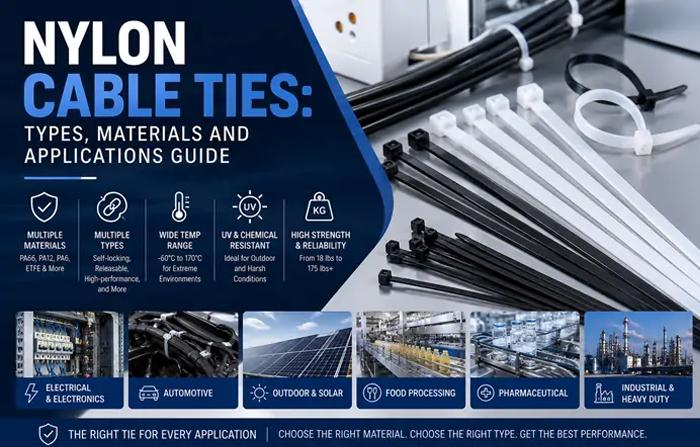
To build a broader understanding of cable tie materials, explore our guide on nylon cable tie types, materials, and applications.
Disclaimer: The material property data and chemical resistance information presented in this article are compiled from industry-standard references and general polymer science knowledge for general informational purposes only. Actual product performance may vary depending on manufacturing processes, material formulations, and specific application conditions. Buyers are strongly encouraged to consult the technical team to confirm product specifications and request material compatibility data for their specific use cases.
NEXT:Heat Stabilized Cable Ties for High Temperature Applications
Interested in cooperation or have questions?
-
 View MoreMiniature Nylon Cable Ties 18 LBS
-
 View MoreIntermediate Nylon Cable Ties 40 LBS
-
 View MoreStandard Nylon Cable Ties 50 LBS
-
View MoreHeavy Duty Nylon Cable Ties 120 175 250 LBS
-
 View MoreBulk Cable Tie Value Pack
-
 View MoreReusable Releasable Cable Ties
-
 View MoreMagic Reusable Cable Ties
-
 View MoreStainless Steel Self Locking Cable Ties
-
 View MorePVC Coated Stainless Steel Cable Ties
-
 View MoreMulti Lock Stainless Steel Cable Ties
-
 View MoreStainless Steel Hose Clamps
-
 View MoreStainless Steel Cable Tie Markers
 LET'S CREATE THE FUTURE TOGETHER

Contact Us Anytime
Our Location
No. 57, Yufang Road, Yangming Sub-district, Yuyao City, Ningbo City, Zhejiang Province, China.


Product Categories
Contact Us
bella@szsplastic.com
+86-15105741066
ivy@szsplastic.com
+86-15958801211
sabrina@szsplastic.com
+86-15205749066
vivian@szsplastic.com
+86-15158306808
allen@szsplastic.com
+86-15205748066
stella@szsplastic.com
+86-15990290008
dora@szsplastic.com
+86-15990281608
pepo@szsplastic.com
+86-15958801191
Copyright © NINGBO SANZHENG PLASTIC CO., LTD. All Rights
Reserved.
