


 English
 Español
 русский


How Much Weight Can Heavy Duty Cable Ties Hold?
A heavy-duty cable tie's load capacity is determined by its width and material composition. A 7.6mm wide heavy-duty tie typically holds 120 lbs (534 N) of tensile strength, while a 12mm ultra-heavy-duty tie can hold 250 lbs (1115 N) or more. These values represent the maximum pulling force the tie can withstand before failure under laboratory conditions. In real-world applications, the effective load capacity depends on installation method, environmental conditions, and the specific material formulation. This guide explains how tensile strength is measured, what factors affect load capacity, and how to select the right tie for your weight requirements.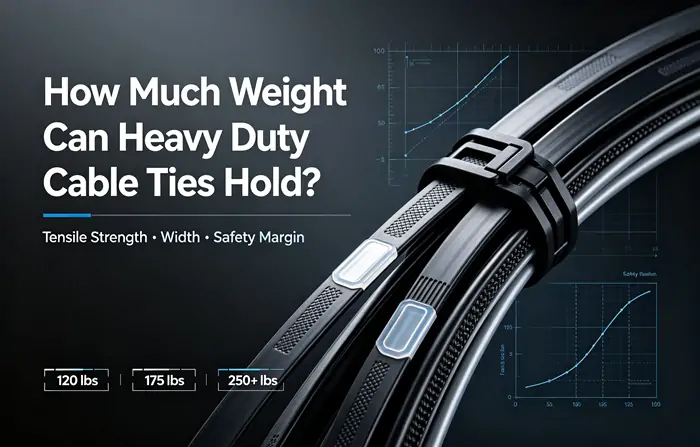
1. What Is Tensile Strength and How Is It Measured?
Tensile strength is the maximum pulling force a cable tie can withstand before it breaks. It is measured in pounds (lbs), kilograms (kg), or newtons (N) under standardized testing conditions.
The test procedure is straightforward:
- The cable tie is looped around a standardized mandrel
- A testing machine pulls the tie at a controlled speed
- The force at which the tie breaks is recorded as its tensile strength
This value is the manufacturer's rated tensile strength — the force the tie can withstand in ideal laboratory conditions. However, the actual working load in real applications should be lower than the rated tensile strength to account for installation variables, environmental factors, and long-term degradation.
2. Heavy Duty Cable Tie Tensile Strength by Width
| Width | Typical Tensile Strength | Equivalent Weight | Typical Applications |
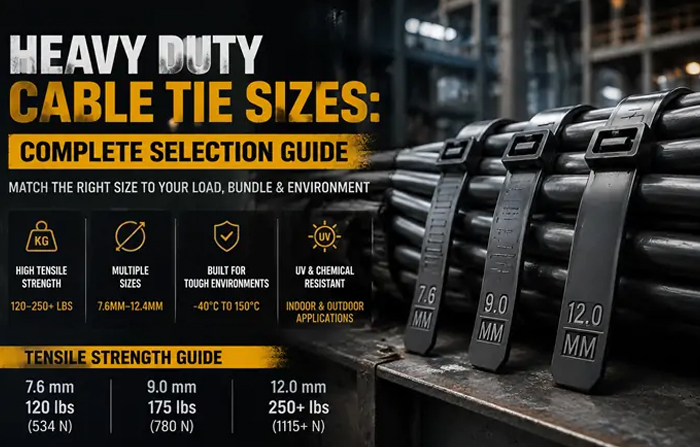
| 7.6 mm | 120 lbs | 534 N | Industrial cable management, general heavy-duty bundling |
| 8.8 – 9.0 mm | 175 lbs | 780 N | Mining, heavy infrastructure, outdoor installations |
| 12.0 – 12.4 mm | 250+ lbs | 1115+ N | Large bundles, containment systems, plant rooms |
To see the full range of heavy-duty options, review the full heavy-duty cable tie range available for industrial applications.
3. What Affects a Cable Tie's Actual Load Capacity?
The rated tensile strength is a laboratory value. In real-world applications, several factors can reduce the effective load capacity:
Installation tension
Over-tensioning during installation can stress the material, creating micro-cracks that weaken the tie over time. Under-tensioning can allow the bundle to shift, placing uneven stress on the tie.
Environmental conditions
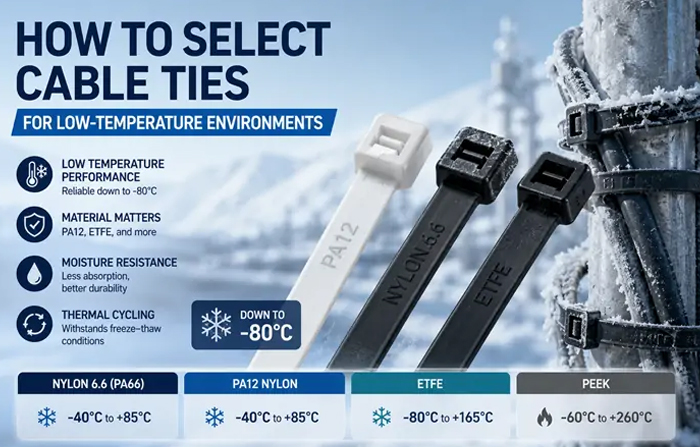
- Temperature: High temperatures can soften nylon and reduce tensile strength. Low temperatures can make nylon brittle and prone to snapping under load.
- UV exposure: Prolonged sunlight exposure degrades nylon through photo-oxidation, reducing tensile strength over time.
- Chemical exposure: Oils, solvents, and corrosive substances can attack the polymer, weakening its structure.
Material formulation
- Standard PA66: Provides good tensile strength but limited UV and chemical resistance
- PA12: Offers similar tensile strength with superior UV resistance and lower moisture absorption
- Heat-stabilized grades: Maintain tensile strength at elevated temperatures up to 150°C
To compare different material options, explore high-performance material options.
Moisture absorption
Nylon 6.6 absorbs moisture from the air — up to 2.5–3.5% at equilibrium. This moisture can affect tensile strength, particularly in humid environments. PA12, with its lower moisture absorption (approximately 0.75%), maintains more consistent tensile strength across varying humidity conditions.
4. How Much Weight Can Different Cable Ties Hold?
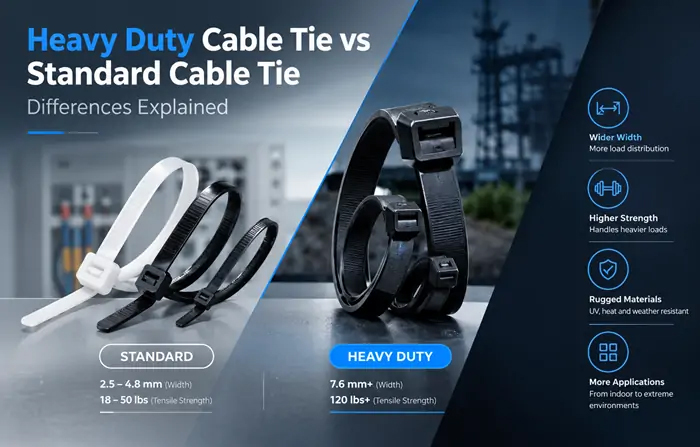
Standard-duty cable ties (2.5 – 4.8 mm width)
Standard-duty ties typically hold 18 to 50 lbs. These are suitable for light cable runs, panel assembly, and general-purpose indoor applications where load requirements are minimal.
Heavy-duty cable ties (7.6 – 8.8 mm width)
Heavy-duty ties hold 120 to 175 lbs. These are designed for industrial cable management, mining operations, infrastructure projects, and applications where standard ties are insufficient.
Ultra-heavy-duty cable ties (9.0 – 12.4 mm width)
Ultra-heavy-duty ties hold 175 to 250+ lbs. These are used for large bundles, containment systems, plant room installations, and safety-critical applications where maximum load capacity is required.
5. What Safety Margin Should You Use?
For load-bearing or safety-critical applications, it is recommended to select a cable tie rated 1.5 to 2 times above the expected load. This safety margin accounts for:
- Installation variations
- Environmental degradation over time
- Dynamic loads (vibration, shock)
- Material ageing
For example, if your application requires holding a 100 lb load, select a tie with a rated tensile strength of at least 150 to 200 lbs.
To compare different models and find the right fit, compare heavy-duty and ultra-heavy-duty models in the full product catalog.
6. Heavy Duty Cable Tie Selection Checklist for Load Capacity
When selecting a heavy-duty cable tie based on weight requirements, verify the following:
- Required load — What is the maximum weight the tie needs to hold?
- Safety margin — Have you applied a 1.5x to 2x safety factor?
- Width requirement — What width corresponds to the required tensile strength?
- Temperature range — Will the tie be exposed to extreme heat or cold?
- UV exposure — Will the tie be used outdoors in direct sunlight?
- Chemical exposure — Will the tie contact oils, solvents, or corrosive substances?
- Installation conditions — Will the tie be installed at room temperature or in the field?
- Certification requirements — Are UL, RoHS, REACH, or other certifications needed?
7. Common Mistakes to Avoid
Mistake 1: Using rated tensile strength as working load
The rated tensile strength is the breaking point under ideal conditions — not the recommended working load. Always apply a safety margin.
Mistake 2: Ignoring environmental degradation
A tie rated for 120 lbs at room temperature may fail at a fraction of that load after prolonged UV exposure, high-temperature operation, or chemical contact.
Mistake 3: Assuming all ties of the same width have the same strength
Material formulation matters. A UV-stabilized PA66 tie and a standard PA66 tie of the same width may have different long-term load capacities.
Mistake 4: Overlooking dynamic loads
Static loads (constant weight) and dynamic loads (vibration, shock, movement) place different stresses on a cable tie. For dynamic applications, select a higher-rated tie or use additional securing methods.
FAQ
Q: How much weight can a 7.6mm heavy-duty cable tie hold?
A 7.6mm wide heavy-duty cable tie typically holds 120 lbs (534 N) of tensile strength.
Q: How much weight can a 12mm ultra-heavy-duty cable tie hold?
A 12mm wide ultra-heavy-duty cable tie can hold 250 lbs (1115 N) or more of tensile strength.
Q: What is the difference between tensile strength and working load?
Tensile strength is the maximum force a tie can withstand before breaking under laboratory conditions. Working load is the recommended maximum load in real-world applications, typically 50–67% of the rated tensile strength.
Q: Does temperature affect how much weight a cable tie can hold?
Yes. High temperatures can soften nylon and reduce tensile strength. Low temperatures can make nylon brittle and prone to snapping under load. FSCAT's high-performance cable ties are designed to maintain tensile strength across -60°C to +150°C
Q: Can I use a heavy-duty cable tie outdoors?
Yes, but you must select UV-stabilized or PA12 materials for outdoor use. PA12 cable ties are engineered for outdoor applications with UV resistance up to 30,000 hours of sunlight exposure.
Q: What safety margin should I use for load-bearing applications?
For load-bearing or safety-critical applications, select a tie rated 1.5 to 2 times above the expected load.
Conclusion
Heavy-duty cable ties offer load capacities ranging from 120 lbs for a 7.6mm wide tie to 250+ lbs for a 12mm ultra-heavy-duty tie. Width is the primary determinant of tensile strength — wider ties deliver higher load capacity. However, the rated tensile strength is a laboratory value; real-world load capacity depends on installation quality, environmental conditions, and material formulation.
The most common mistake is treating the rated tensile strength as the working load. Always apply a safety margin of 1.5 to 2 times the expected load, and consider environmental factors such as temperature, UV exposure, and chemical contact when selecting a tie for your application.
For a complete overview of available heavy-duty and ultra-heavy-duty cable tie configurations, review the full product catalog. If your application has specific load, temperature, or environmental requirements, consult the technical team for material recommendations and tensile strength verification.
For more information on heavy-duty cable tie sizing, explore our guide on heavy-duty cable tie sizes.
Disclaimer: The tensile strength values and load capacity data presented in this article are compiled from industry-standard references and general engineering knowledge for general informational purposes only. Actual product performance may vary depending on manufacturing processes, material formulations, installation methods, and specific application conditions. Buyers are strongly encouraged to consult the technical team to confirm product specifications for their specific use cases. All product specifications are subject to change without prior notice.
NEXT:How Much Weight Can Heavy Duty Cable Ties Hold?
Interested in cooperation or have questions?
-
 View MoreMiniature Nylon Cable Ties 18 LBS
-
 View MoreIntermediate Nylon Cable Ties 40 LBS
-
 View MoreStandard Nylon Cable Ties 50 LBS
-
View MoreHeavy Duty Nylon Cable Ties 120 175 250 LBS
-
 View MoreBulk Cable Tie Value Pack
-
 View MoreReusable Releasable Cable Ties
-
 View MoreMagic Reusable Cable Ties
-
 View MoreStainless Steel Self Locking Cable Ties
-
 View MorePVC Coated Stainless Steel Cable Ties
-
 View MoreMulti Lock Stainless Steel Cable Ties
-
 View MoreStainless Steel Hose Clamps
-
 View MoreStainless Steel Cable Tie Markers
 LET'S CREATE THE FUTURE TOGETHER

Contact Us Anytime
Our Location
No. 57, Yufang Road, Yangming Sub-district, Yuyao City, Ningbo City, Zhejiang Province, China.


Product Categories
Contact Us
bella@szsplastic.com
+86-15105741066
ivy@szsplastic.com
+86-15958801211
sabrina@szsplastic.com
+86-15205749066
vivian@szsplastic.com
+86-15158306808
allen@szsplastic.com
+86-15205748066
stella@szsplastic.com
+86-15990290008
dora@szsplastic.com
+86-15990281608
pepo@szsplastic.com
+86-15958801191
Copyright © NINGBO SANZHENG PLASTIC CO., LTD. All Rights
Reserved.
