


 English
 Español
 русский



Why Nylon Cable Ties Absorb Moisture and How It Affects Performance
Nylon cable ties absorb moisture because polyamide polymers contain amide groups that attract and bond with water molecules. Standard PA66 absorbs approximately 2.5% moisture at equilibrium, while PA6 absorbs approximately 3.5%. This absorption affects tensile strength, dimensional stability, and locking performance — and in cold environments, absorbed moisture can freeze and cause embrittlement. Understanding why moisture absorption happens and how to manage it helps buyers select the right material and storage conditions for their application. To see the full range of nylon cable ties available, explore the full nylon cable tie range.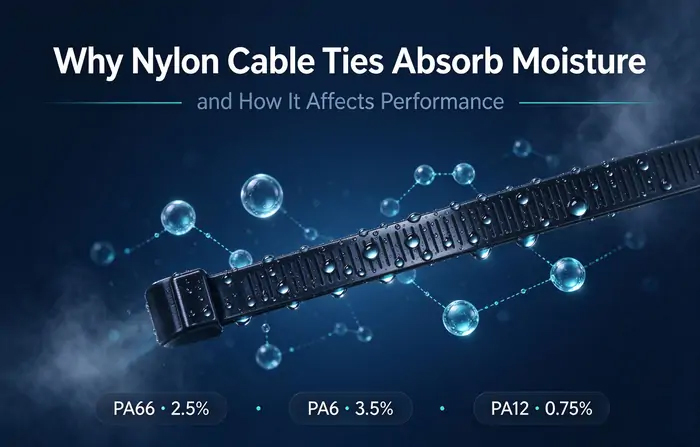
1. Why Nylon Absorbs Moisture
Nylon is a polyamide — a polymer chain containing repeating amide groups (-CO-NH-). The amide group is polar, meaning it has a partial negative charge on the oxygen atom and a partial positive charge on the hydrogen atom. Water molecules are also polar. This polarity creates an attraction between the amide groups in nylon and water molecules in the surrounding air.
When nylon is exposed to humid air, water molecules diffuse into the polymer matrix and form hydrogen bonds with the amide groups. This process continues until the material reaches equilibrium with the surrounding environment — a state where the rate of water absorption equals the rate of water release.
The amount of moisture absorbed at equilibrium depends on:
- Material type: PA6 absorbs more moisture than PA66; PA12 absorbs much less
- Relative humidity: Higher humidity means higher equilibrium moisture content
- Temperature: Higher temperatures generally increase absorption rate
- Exposure time: Nylon reaches equilibrium over hours or days, depending on thickness
2. Moisture Absorption by Nylon Grade
| Material | Equilibrium Moisture Content | Relative Absorption |
| PA6 | 3.50% | Highest |
| PA66 | 2.50% | Moderate |
| PA11 | 2.70% | Moderate |
| PA12 | 0.75% | Lowest |
| ETFE | Negligible | None |
These values represent equilibrium moisture content at 23°C and 50% relative humidity. Actual values vary with environmental conditions.
3. How Moisture Affects Cable Tie Performance
Moisture absorption affects nylon cable ties in several ways. For a detailed comparison of how PA66 and PA6 differ in moisture behavior, compare PA66 and PA6 material properties.
Dimensional changes
When nylon absorbs moisture, it swells. The swelling is not uniform in all directions — it is more pronounced in the direction perpendicular to the polymer chains. For a cable tie, this can affect:
- The fit of the tie through mounting holes
- The engagement of the locking mechanism
- The overall length and width of the tie
In precision applications, dimensional changes of even a fraction of a millimeter can affect performance.
Tensile strength changes
Moisture acts as a plasticizer in nylon. At low moisture content, nylon is stronger but more brittle. As moisture content increases, nylon becomes more flexible but loses some tensile strength.
For cable ties, this means:
- Dry ties may be stronger but more prone to snapping under sudden impact
- Conditioned ties may be more flexible but have slightly lower maximum load capacity
The relationship between moisture content and tensile strength is not linear — there is an optimal range for specific applications.
Locking mechanism performance
The locking mechanism of a cable tie relies on precise dimensional tolerances between the pawl and the serrations on the strap. When the strap absorbs moisture and swells, the fit between these components can change. In extreme cases, this can affect:
- Insertion force required to tighten the tie
- Holding strength of the locking mechanism
- Release characteristics of releasable ties
Cold environment embrittlement
In cold environments, absorbed moisture can freeze. Ice crystals form within the polymer matrix, reducing ductility and making the material brittle. A cable tie that performs well at room temperature may snap during installation at -20°C if it has absorbed moisture.
This is why low-temperature cable ties are often dried before packaging, and why storage in sealed packaging is important for cold-environment applications.
4. Drying and Conditioning Nylon Cable Ties
Because moisture absorption affects performance, manufacturers often dry nylon cable ties before packaging. Drying removes excess moisture and brings the material to a controlled moisture content.
Drying process:
- Nylon pellets are dried before injection molding to prevent processing defects
- Finished cable ties may be conditioned to a specific moisture content
- Packaging in sealed bags or containers prevents moisture reabsorption during storage
Conditioning:
Some applications require cable ties to be conditioned to a specific moisture content before use. Conditioning involves exposing the ties to a controlled humidity environment until they reach equilibrium. This ensures consistent performance in the application.
For applications requiring minimal moisture absorption, PA12 or ETFE cable ties are alternatives. To compare options, review high-performance material options.
5. How to Minimize Moisture-Related Issues
Storage recommendations:
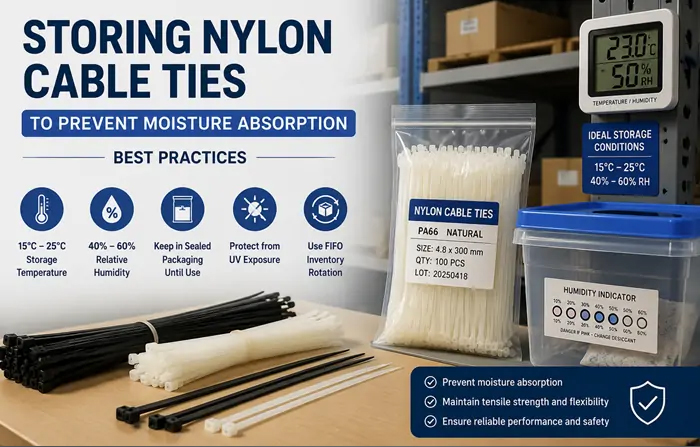
- Store cable ties in sealed, moisture-proof packaging until installation
- Avoid opening packaging until the ties are needed
- Store in a dry, climate-controlled environment when possible
- Use desiccant packets in storage containers for critical applications
Handling recommendations:
- Minimize exposure to humid air before installation
- Install ties promptly after removing from packaging
- For cold-environment installations, keep ties in sealed packaging until installation
Material selection:
- For humid environments, PA66 offers better dimensional stability than PA6
- For extremely humid or wet environments, PA12 offers the lowest moisture absorption
- For chemical or extreme environments, ETFE offers negligible moisture absorption
6. Moisture Absorption in Different Applications
| Application | Moisture Concern | Recommended Material |
| Indoor, climate-controlled | Low | PA66 or PA6 |
| Outdoor, humid climate | High | PA12 or UV-stabilized PA66 |
| Cold storage / freezer | High (freeze risk) | Low-temperature PA66 or PA12 |
| Marine / offshore | High | PA12 or ETFE |
| Food processing (washdown) | High | PA12 or metal detectable PA66 |
| Automotive under-hood | Moderate | PA66 (heat-stabilized) |
| General electrical | Low | PA66 |
If you are unsure which material fits your moisture conditions, consult the technical team for guidance.
7. Common Mistakes to Avoid
Mistake 1: Assuming all nylon cable ties absorb the same amount of moisture
PA6 absorbs approximately 3.5% moisture, while PA66 absorbs approximately 2.5%, and PA12 absorbs only 0.75%. The difference affects dimensional stability and performance in humid environments.
Mistake 2: Ignoring moisture in cold-environment applications
Absorbed moisture can freeze and cause embrittlement. Cable ties for cold environments should be dried and stored in sealed packaging until installation.
Mistake 3: Storing cable ties in open packaging
Nylon absorbs moisture from ambient air. Once packaging is opened, ties begin to absorb moisture. For critical applications, use sealed containers with desiccant.
Mistake 4: Assuming moisture absorption only affects strength
Moisture absorption affects dimensional stability, locking mechanism performance, and cold-environment behavior — not just tensile strength.
FAQ
Q: Why do nylon cable ties absorb moisture?
Nylon contains amide groups that are polar and attract water molecules. Water diffuses into the polymer matrix and forms hydrogen bonds with these groups until equilibrium is reached.
Q: How much moisture does a nylon cable tie absorb?
PA66 absorbs approximately 2.5% moisture at equilibrium. PA6 absorbs approximately 3.5%. PA12 absorbs approximately 0.75%. These values depend on relative humidity and temperature.
Q: Does moisture absorption affect cable tie strength?
Yes. Moisture acts as a plasticizer, making nylon more flexible but slightly reducing tensile strength. The effect is generally moderate but can be significant in critical applications.
Q: Can moisture absorption cause cable ties to fail in cold weather?
Yes. Absorbed moisture can freeze and form ice crystals within the polymer, causing embrittlement. This is why low-temperature cable ties are dried before packaging.
Q: How should I store nylon cable ties?
Store them in sealed, moisture-proof packaging until installation. Avoid opening packaging until the ties are needed. For critical applications, use desiccant packets in storage containers.
Q: Which nylon grade absorbs the least moisture?
PA12 absorbs the least moisture among common nylon grades — approximately 0.75% at equilibrium. ETFE absorbs virtually no moisture.
Q: Does moisture absorption affect the locking mechanism?
Yes. When the strap swells, the fit between the pawl and serrations can change, affecting insertion force, holding strength, and release characteristics.
Q: How can I tell if my cable ties have absorbed too much moisture?
Visual inspection is not reliable. For critical applications, request moisture content data from the supplier or use a moisture analyzer to verify.
Conclusion
Moisture absorption is an inherent property of nylon cable ties. The amide groups in polyamide attract water molecules, and the amount absorbed depends on the material type, humidity, and temperature. PA6 absorbs more moisture than PA66, while PA12 absorbs significantly less than both.
The effects of moisture absorption include dimensional changes, tensile strength changes, locking mechanism performance shifts, and cold-environment embrittlement. Managing these effects requires selecting the right material for the environment, storing ties in sealed packaging, and conditioning ties when necessary.
The most common mistake is ignoring moisture absorption until a failure occurs. For humid environments, PA66 offers better dimensional stability than PA6. For extremely humid or wet environments, PA12 is the better choice. For cold environments, dried and sealed packaging is essential.
Disclaimer: The moisture absorption data and material property information presented in this article are compiled from industry-standard references and general polymer science knowledge for general informational purposes only. Actual product performance may vary depending on manufacturing processes, material formulations, storage conditions, and specific application requirements. Buyers are strongly encouraged to consult the technical team to confirm product specifications and request moisture content data for their specific use cases.
NEXT:PTFE Cable Ties vs Nylon Cable Ties for Extreme Environments
Interested in cooperation or have questions?
-
 View MoreMiniature Nylon Cable Ties 18 LBS
-
 View MoreIntermediate Nylon Cable Ties 40 LBS
-
 View MoreStandard Nylon Cable Ties 50 LBS
-
View MoreHeavy Duty Nylon Cable Ties 120 175 250 LBS
-
 View MoreBulk Cable Tie Value Pack
-
 View MoreReusable Releasable Cable Ties
-
 View MoreMagic Reusable Cable Ties
-
 View MoreStainless Steel Self Locking Cable Ties
-
 View MorePVC Coated Stainless Steel Cable Ties
-
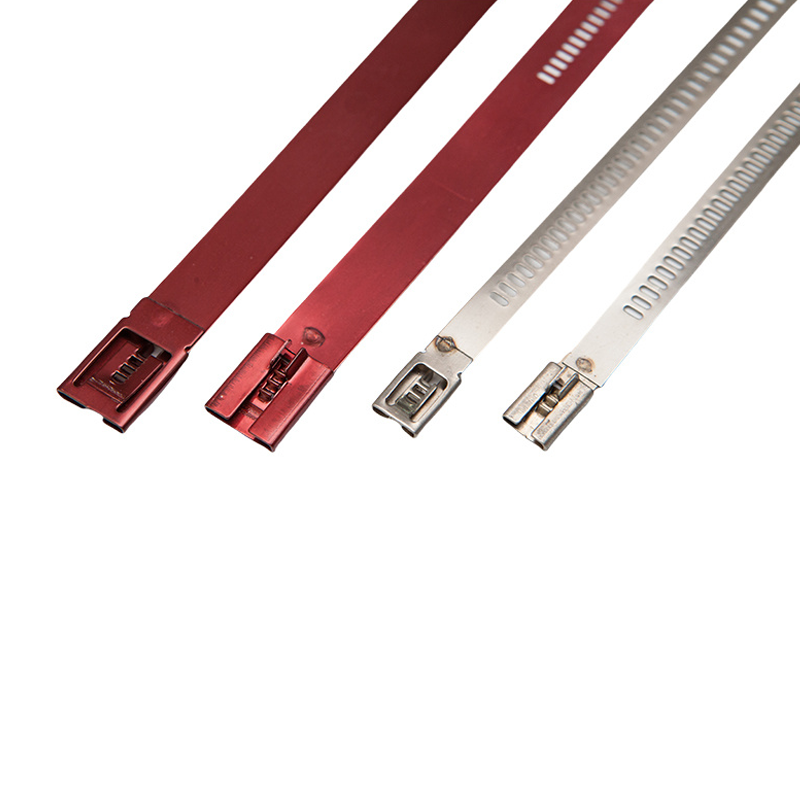 View MoreMulti Lock Stainless Steel Cable Ties
-
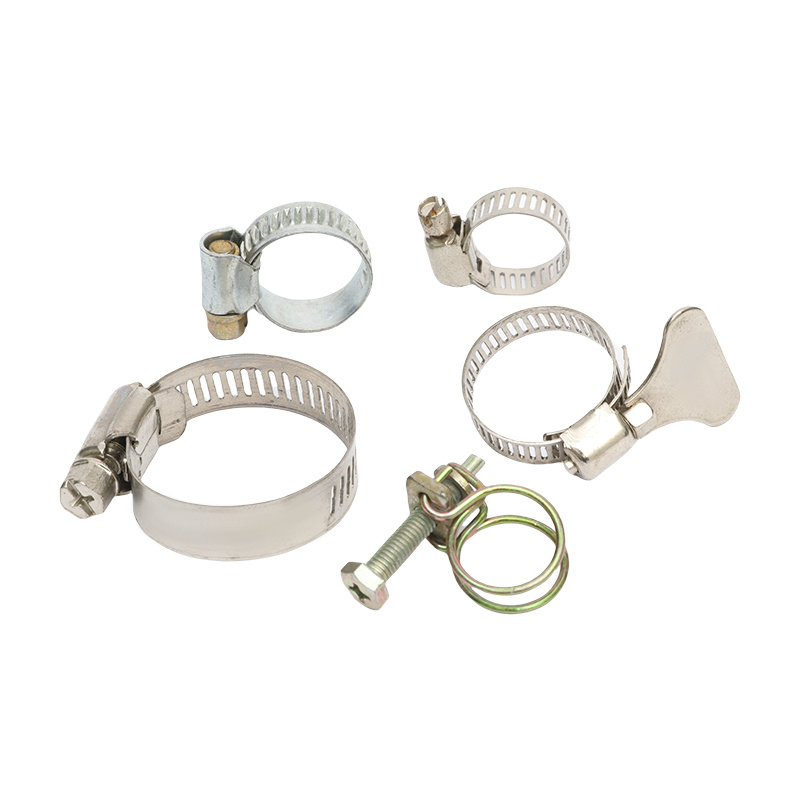 View MoreStainless Steel Hose Clamps
-
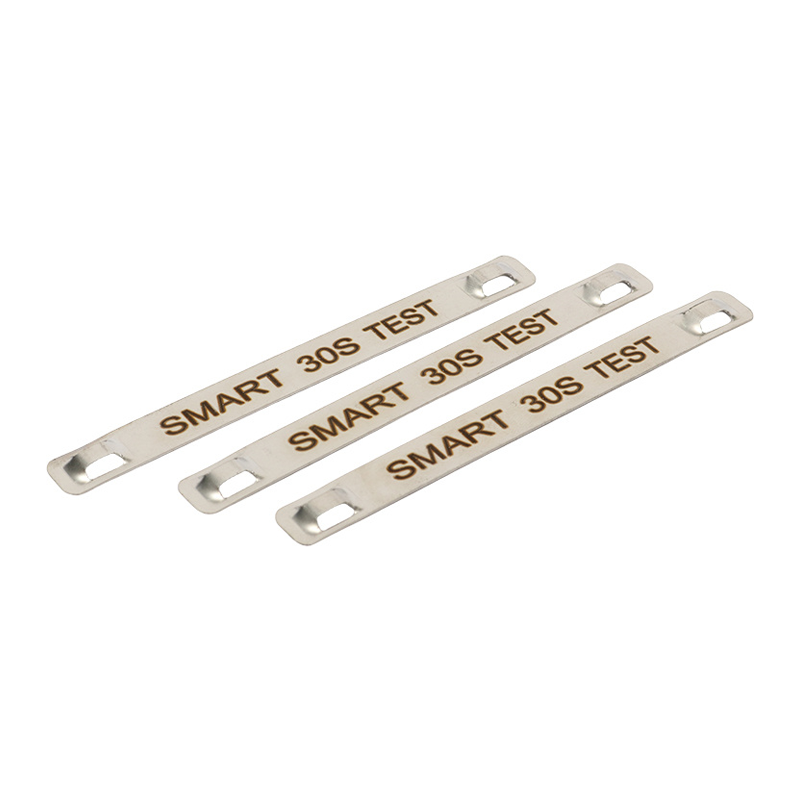 View MoreStainless Steel Cable Tie Markers
 LET'S CREATE THE FUTURE TOGETHER

Contact Us Anytime
Our Location
No. 57, Yufang Road, Yangming Sub-district, Yuyao City, Ningbo City, Zhejiang Province, China.


Product Categories
Contact Us
bella@szsplastic.com
+86-15105741066
ivy@szsplastic.com
+86-15958801211
sabrina@szsplastic.com
+86-15205749066
vivian@szsplastic.com
+86-15158306808
allen@szsplastic.com
+86-15205748066
stella@szsplastic.com
+86-15990290008
dora@szsplastic.com
+86-15990281608
pepo@szsplastic.com
+86-15958801191
Copyright © NINGBO SANZHENG PLASTIC CO., LTD. All Rights
Reserved.
