


 English
 Español
 русский



How Metal Detectable Nylon Cable Ties Improve Food Safety
In food, beverage, and pharmaceutical production, even a small fragment of plastic can trigger a costly product recall. Standard nylon cable ties—used to secure cables, hoses, and machine guards throughout processing facilities—pose a hidden risk: if a cut-off tail or broken tie ends up in a product, it is virtually invisible to conventional metal detectors and X-ray systems. Metal detectable nylon cable ties are engineered to close this gap. Made from a metal-impregnated material, these ties can be identified by metal detectors, X-ray inspection equipment, and magnetic separators—turning an undetectable hazard into a findable one.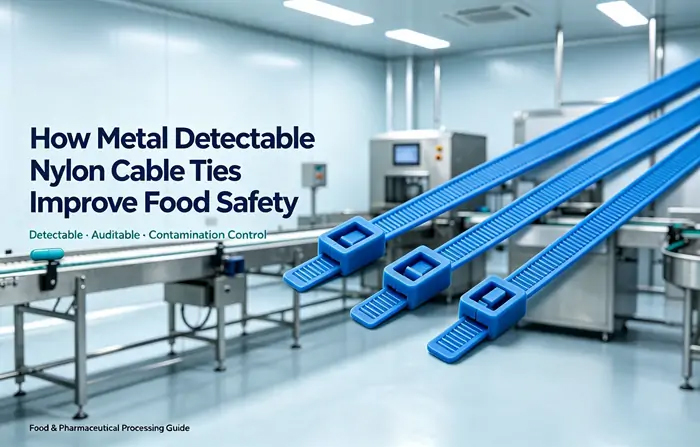
1. The Foreign Object Contamination Problem
Food safety standards such as HACCP, BRC Global Standard, and IFS require manufacturers to identify and control all potential sources of physical contamination. While much attention goes to glass, metal shavings, and hard plastics, the small plastic accessories used in production equipment are often overlooked.
Standard nylon cable ties are made from PA66, which has a density similar to many food products. This means they do not reliably show up on X-ray inspection. A piece of a cut cable tie tail—typically 2.5mm to 4.8mm wide and a few millimeters long—can easily go undetected, yet still be large enough to cause a consumer complaint or regulatory action.
2. How Metal Detectable Cable Ties Work
According to the product specifications on the FSCAT metal detectable cable ties page, these ties are manufactured with a metal-impregnated material. The metallic pigment is distributed throughout the tie body and head, which means even cut-off tail sections remain detectable.
The detection methods that work with these ties include:
- Metal detectors – Standard inline metal detection systems found in most food and pharmaceutical plants can identify fragments of metal detectable cable ties.
- X-ray inspection – Unlike standard nylon, the metal-impregnated material has enough density contrast to be visible on X-ray imaging systems used for final product inspection.
- Magnetic separation – The metallic content allows fragments to be captured by magnetic grids or separators commonly positioned at critical control points.
The product page also notes that the ties are a teal color per common industry practice, providing easy visual identification. This color coding helps auditors and line operators quickly verify that the correct food-safe ties are installed and that standard, non-detectable ties have not been substituted.
3. Where Metal Detectable Cable Ties Are Used
The FSCAT product page specifies that these ties are designed for use in the food, beverage, and pharmaceutical processing industries. Typical applications within these facilities include:
- Securing electrical cables and sensor wiring along conveyor lines
- Bundling hydraulic hoses and pneumatic tubing on filling machines
- Fastening pipe insulation and protective sleeving in washdown zones
- Attaching identification tags and maintenance labels to equipment
- Temporary fixing during line setup or maintenance procedures
- Cable management inside control panels near production areas
In each case, the tie remains in close proximity to the product stream. If a tie breaks or a tail is clipped and falls, the metal detectable property ensures it will be captured before reaching finished goods.
4. Specification Considerations for Food Production Environments
When selecting metal detectable cable ties, the same mechanical requirements apply as with any industrial cable tie: tensile strength, length, width, and bundle diameter must match the application. The FSCAT product page lists a wide range of sizes—from 2.5mm × 100mm ties with an 80N tensile strength to heavy-duty 7.6mm × 550mm ties rated at 560N. The material is identified as PA66MP (Polyamide 6.6 with metal pigment), with an operating temperature range of 0°C to 85°C.
For wet or washdown areas, buyers should verify chemical resistance. The product page states that the material has good resistance to oils and greases, and excellent resistance to petrol. Resistance to solvents is rated as good. These properties should be evaluated against the specific cleaning chemicals and sanitizers used in each facility.
For dry or low-temperature environments such as cold storage, the specification notes a minimum operating temperature of 0°C. Standard metal detectable ties may not be suitable for deep-freeze applications—a point to confirm with the supplier if required. For the complete range of dimensions and tensile strengths, you can view the full product specifications.
5. Visual Detection and Audit Readiness
Beyond machine detection, the teal color standard serves an important operational function. During food safety audits, whether internal or third-party, the auditor will check that all temporary fasteners in production areas are appropriate for the environment. A standard black or natural nylon tie immediately draws attention as a potential risk. Teal-colored detectable ties provide visible evidence that the facility has a contamination control system in place.
This visual identification also helps maintenance teams during line repairs. When all permitted cable ties share a distinctive color, it becomes easy to spot where a standard tie has been mistakenly used, reducing the chance of an undetected substitution.
6. Practical Checklist for Implementing Metal Detectable Cable Ties
When introducing detectable cable ties into a production facility, consider these steps:
- Identify all current locations where standard cable ties are used in production, packaging, and maintenance areas
- Replace standard ties with metal detectable versions at every point where tie fragments could enter the product stream
- Document the specification in the site's HACCP plan or prerequisite program
- Verify that inline metal detectors and X-ray systems are calibrated to detect small fragments of the tie material
- Train maintenance and sanitation teams to recognize the teal color and report any standard ties found in production zones
- Include cable tie inspection in routine line audits and pre-production checks
This is not a one-time change—it requires ongoing discipline to ensure replacement ties purchased over time maintain the same detectable specification.
Frequently Asked Questions
Q: Can standard metal detectors reliably find fragments of metal detectable cable ties?
A: The metal-impregnated material is designed to be detectable by standard inline metal detection equipment. However, detection sensitivity depends on fragment size, detector calibration, and product effect. Buyers should test with actual detector settings and tie sizes used in their facility.
Q: How small a fragment can be detected?
A: The minimum detectable fragment size depends on the specific detection equipment, the product being inspected, and the orientation of the fragment. The product page indicates that even small cut-off sections can be identified, but actual performance should be verified under real production conditions.
Q: Are metal detectable cable ties more expensive than standard nylon ties?
A: Because of the specialized material and manufacturing process, metal detectable ties typically cost more than standard PA66 ties. However, this cost must be weighed against the potential expense of a product recall or food safety incident.
Q: Do metal detectable cable ties have the same strength as standard nylon ties?
A: The FSCAT product page lists tensile strengths from 80N to 560N depending on the size, which is consistent with standard nylon cable tie ratings. The specific strength required depends on the bundle weight and application.
Q: Can metal detectable cable ties be used in microwave or oven applications?
A: No. The operating temperature range is specified as 0°C to 85°C. They are not suitable for high-temperature processing environments or direct food contact applications involving heat.
Q: Are these ties suitable for organic or clean-label certified facilities?
A: The metal-impregnated compound is designed for detection purposes, not as a food ingredient. Buyers should confirm with their certification body whether the specific material grade (PA66MP) is acceptable for their facility's certification requirements.
Conclusion
Metal detectable nylon cable ties address a specific but critical food safety risk: the undetectable plastic fragment. By combining a metal-impregnated material with a standardized teal color, they provide both machine-based detection and visual verification that standard nylon ties cannot offer.
For food, beverage, and pharmaceutical manufacturers operating under HACCP-based systems, switching to metal detectable ties in production areas is a practical step toward closing a contamination gap. The key implementation factors to evaluate are detector sensitivity for the specific tie sizes used, material compatibility with cleaning chemicals, and integration into existing audit and maintenance procedures.
If you need to confirm detection performance with your own equipment or have specific application requirements, contact FSCAT to discuss your food safety needs.
NEXT:How to Select Cable Ties for Low-Temperature Environments – What Works at -40°C
Interested in cooperation or have questions?
-
 View MoreMiniature Nylon Cable Ties 18 LBS
-
 View MoreIntermediate Nylon Cable Ties 40 LBS
-
 View MoreStandard Nylon Cable Ties 50 LBS
-
View MoreHeavy Duty Nylon Cable Ties 120 175 250 LBS
-
 View MoreBulk Cable Tie Value Pack
-
 View MoreReusable Releasable Cable Ties
-
 View MoreMagic Reusable Cable Ties
-
 View MoreStainless Steel Self Locking Cable Ties
-
 View MorePVC Coated Stainless Steel Cable Ties
-
 View MoreMulti Lock Stainless Steel Cable Ties
-
 View MoreStainless Steel Hose Clamps
-
 View MoreStainless Steel Cable Tie Markers
 LET'S CREATE THE FUTURE TOGETHER

Contact Us Anytime
Our Location
No. 57, Yufang Road, Yangming Sub-district, Yuyao City, Ningbo City, Zhejiang Province, China.


Product Categories
Contact Us
bella@szsplastic.com
+86-15105741066
ivy@szsplastic.com
+86-15958801211
sabrina@szsplastic.com
+86-15205749066
vivian@szsplastic.com
+86-15158306808
allen@szsplastic.com
+86-15205748066
stella@szsplastic.com
+86-15990290008
dora@szsplastic.com
+86-15990281608
pepo@szsplastic.com
+86-15958801191
Copyright © NINGBO SANZHENG PLASTIC CO., LTD. All Rights
Reserved.
