


 English
 Español
 русский


Storing Nylon Cable Ties to Prevent Moisture Absorption – Best Practices
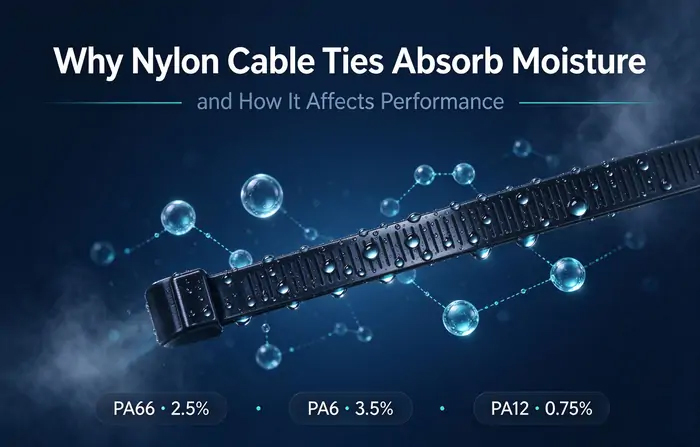
Nylon 6.6—the material used to manufacture most industrial cable ties—is hygroscopic. It absorbs moisture from the surrounding air, and the amount of water it takes on directly affects its mechanical properties. A batch of Nylon Cable Ties stored in an uncontrolled environment can lose a measurable percentage of its tensile strength before it ever reaches the application. The ties may look identical to a properly stored batch, but their performance under load will differ. Understanding the relationship between nylon, moisture, and storage conditions is the first step toward protecting product quality from warehouse to installation.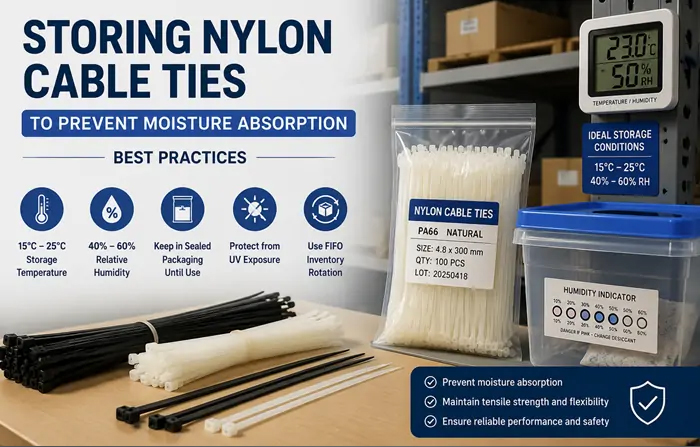
How Moisture Affects Nylon 6.6 Cable Ties
Nylon 6.6 at equilibrium with standard atmospheric conditions contains approximately 2.5% water by weight. This is the material's equilibrium water absorption at 50% relative humidity and 23°C—a condition specified in ISO 62 for water absorption testing. At this moisture level, the polymer chains have absorbed enough water to provide the flexibility that makes nylon cable ties easy to install, without compromising the tensile strength required for secure fastening.
The problem occurs when storage conditions push moisture content beyond equilibrium. At 85% relative humidity, nylon 6.6 can absorb enough water to measurably soften the material. Tensile strength decreases as water molecules act as plasticisers between the polymer chains, reducing the intermolecular forces that give nylon its load-bearing capability. A cable tie that meets its rated loop tensile strength at 2.5% moisture content may fall below specification if moisture absorption exceeds 3.5%.
The reverse condition is equally problematic. Nylon stored in extremely dry conditions—below 20% relative humidity—loses its conditioning moisture and becomes brittle. The tie may meet tensile strength specifications in a laboratory pull test, but the reduced flexibility increases the risk of fracture at the bend point during installation, particularly for ties with sharp corner profiles or those installed under high tension.
Recommended Storage Conditions
The ideal storage environment for nylon cable ties maintains conditions close to the material's equilibrium point. A temperature range of 15°C to 25°C combined with relative humidity between 40% and 60% preserves the moisture content that manufacturers build into the product through conditioning processes before packaging. These conditions apply both to bulk storage in distribution centres and to shelf storage in electrical workshops and manufacturing facilities.
Temperature excursions above 30°C accelerate two degradation mechanisms simultaneously. First, the rate of moisture absorption increases with temperature because warmer air can hold more water vapour. Second, thermal oxidation of the nylon polymer begins to occur at measurable rates, particularly if the material contains no heat stabiliser additives. While standard PA66 cable ties are typically rated for continuous use at temperatures up to 85°C, that rating assumes intermittent exposure during service life, not continuous storage. Long-term storage at elevated temperatures reduces the useful service life of the tie before it is even installed.
Sealed Packaging and Moisture Barrier Protection
The most effective method for preventing moisture-related degradation during storage is to keep cable ties in their original sealed packaging until immediately before use. Quality manufacturers package nylon cable ties in sealed plastic bags that maintain the conditioned moisture level established during production. Once opened, the contents of a bag begin equilibrating with the ambient environment. If the ambient humidity differs significantly from the 40–60% range, the ties will gain or lose moisture accordingly.
For operations that use cable ties in small quantities across extended periods, resealing opened bags with desiccant packets or transferring ties to airtight containers with humidity indicators provides an additional layer of protection. Silica gel desiccants can maintain relative humidity below 60% inside a sealed container, though operators should avoid over-drying by selecting desiccant quantities appropriate to the container volume.
UV exposure during storage is an additional consideration for facilities with outdoor or window-adjacent storage areas. Standard PA66 cable ties without UV stabilisers will degrade when exposed to direct sunlight for extended periods. Even ties rated for outdoor use—typically those made from UV-resistant PA66 or PA12 formulations—should be stored away from direct light to maximise their service life. The UV resistance built into weather-resistant formulations is designed for service conditions, not indefinite storage under sunlight.
Pre-Use Conditioning for Extremely Dry Environments
In regions with consistently low humidity, or in facilities where cable ties are stored in climate-controlled rooms with dehumidification, the ties may dry below their optimal moisture content before use. Cable ties that feel stiff or produce a cracking sound when bent indicate insufficient moisture content. These ties can be reconditioned by exposing them to ambient air at 40–60% relative humidity for 24 to 48 hours before installation. The conditioning process allows the nylon to reabsorb moisture to its equilibrium level, restoring the flexibility needed for reliable installation.
This reconditioning step is particularly important for ties that will be installed under tension in cold environments. A dry, brittle tie installed at -10°C faces a higher risk of fracture than a properly conditioned tie at the same temperature because the combined effects of low temperature and low moisture content both reduce flexibility.
For those sourcing ties that will be stored for extended periods before use, reviewing nylon cable tie specifications and material options can help identify formulations that maintain their mechanical properties across a wider range of storage conditions. PA12 formulations, for example, absorb less moisture at equilibrium than PA66, making them less sensitive to humidity fluctuations during storage.
Inventory Rotation and Shelf Life Management
Nylon cable ties do not have a fixed expiration date, but their properties can drift over years of storage, particularly in suboptimal conditions. A first-in-first-out inventory rotation system ensures that older stock is used before newly received material, minimising the average storage time for each batch. Ties stored in sealed packaging under recommended conditions for less than two years should perform within their original specifications. For ties stored beyond this period or in conditions that deviate from recommendations, a sample pull test comparing tensile strength against the manufacturer's specification can determine whether the batch remains suitable for use.
The pull test method is straightforward: select a statistically representative sample from the stored batch, condition it at standard laboratory atmosphere (23°C, 50% RH) for 24 hours if they have been stored in non-standard conditions, then test loop tensile strength according to the procedure described by the manufacturer or by standards such as MIL-S-23190E. If the average tensile strength of the sample meets or exceeds the minimum specification for that tie size and material, the batch can be released for use.
Practical Guidelines Summary
The following practices summarise the key storage recommendations for maintaining nylon cable tie performance from receipt to installation:
-
Maintain storage temperature between 15°C and 25°C and relative humidity between 40% and 60%.
-
Keep ties in original sealed packaging until immediately before use.
-
For opened packages, use sealed containers with humidity indicators and appropriate desiccant quantities.
-
Protect stored ties from direct UV exposure, regardless of UV resistance rating.
-
Use first-in-first-out inventory rotation to minimise storage duration.
-
Condition excessively dry ties at 40–60% RH for 24–48 hours before installation.
-
Verify tensile strength of long-stored or questionably stored batches through sample pull testing.
For operations establishing or upgrading their cable tie storage procedures, FSCAT's range of nylon cable tie products includes detailed material specifications and conditioning recommendations to support proper storage planning.
NEXT:Colored Nylon Cable Ties: What Do Different Colors Mean for Identification and Safety?
Interested in cooperation or have questions?
-
 View MoreMiniature Nylon Cable Ties 18 LBS
-
 View MoreIntermediate Nylon Cable Ties 40 LBS
-
 View MoreStandard Nylon Cable Ties 50 LBS
-
View MoreHeavy Duty Nylon Cable Ties 120 175 250 LBS
-
 View MoreBulk Cable Tie Value Pack
-
 View MoreReusable Releasable Cable Ties
-
 View MoreMagic Reusable Cable Ties
-
 View MoreStainless Steel Self Locking Cable Ties
-
 View MorePVC Coated Stainless Steel Cable Ties
-
 View MoreMulti Lock Stainless Steel Cable Ties
-
 View MoreStainless Steel Hose Clamps
-
 View MoreStainless Steel Cable Tie Markers
 LET'S CREATE THE FUTURE TOGETHER

Contact Us Anytime
Our Location
No. 57, Yufang Road, Yangming Sub-district, Yuyao City, Ningbo City, Zhejiang Province, China.


Product Categories
Contact Us
bella@szsplastic.com
+86-15105741066
ivy@szsplastic.com
+86-15958801211
sabrina@szsplastic.com
+86-15205749066
vivian@szsplastic.com
+86-15158306808
allen@szsplastic.com
+86-15205748066
stella@szsplastic.com
+86-15990290008
dora@szsplastic.com
+86-15990281608
pepo@szsplastic.com
+86-15958801191
Copyright © NINGBO SANZHENG PLASTIC CO., LTD. All Rights
Reserved.
