


 English
 Español
 русский


Colored Nylon Cable Ties: What Do Different Colors Mean for Identification and Safety?
Walk through any electrical cabinet, data center, or automotive wiring harness, and the first thing that stands out is not the cables themselves—it is the colored bands wrapped around them. A row of red ties marks emergency power circuits. Yellow bands identify gas-related wiring. Blue ties distinguish low-voltage data lines from high-voltage power feeds. These color choices are rarely random; in most cases, they follow an established identification system that helps technicians diagnose, maintain, and repair systems faster and with fewer errors.
A nylon cable tie is available in a wide range of colors, and each color serves a functional purpose beyond aesthetics. Understanding what different colors mean in various industries helps procurement teams specify the right products and helps installation teams apply them consistently. This guide explains the most common color coding conventions, the role of color in safety and compliance, and how to select colored ties for specific applications.
The Functional Purpose of Cable Tie Colors
Colored cable ties serve three primary functions: identification, safety warning, and compliance marking.
Identification. In complex wiring systems, colored ties create visual labels that are faster to read than printed tags. A technician troubleshooting a control panel can instantly identify circuit groups by color without tracing each wire back to its source. This is particularly valuable in industrial machinery, where downtime costs can run into thousands of dollars per hour, and every minute saved on diagnosis translates directly to the bottom line.
Safety warning. Some colors convey safety-critical information. Red ties are widely used to mark fire alarm circuits, emergency stop wiring, or high-voltage conductors. Yellow ties indicate caution—gas pipes, chemical lines, or moving parts that require awareness. When a color convention is applied consistently across a facility, a maintenance technician who may not be familiar with a specific machine can still recognize hazard-coded wiring at a glance.
Compliance marking. Certain industries mandate specific color coding through standards and regulations. Telecommunications infrastructure often uses a standardized color sequence—blue, orange, green, brown, slate, white, red, black, yellow, violet, rose, aqua—to identify individual fibers or cable pairs in multi-conductor bundles. Medical gas systems follow strict color codes defined by national standards to prevent cross-connection between oxygen, nitrous oxide, vacuum, and compressed air lines. In these applications, the color of the tie is not optional; it is part of the compliance framework.
Common Color Codes and Their Meanings
While color conventions vary by industry and region, several color associations appear consistently across applications:
Black. The most common color, used for general-purpose bundling where identification is not required. Black ties contain UV-stabilizing carbon black, making them suitable for outdoor use where sunlight exposure would degrade uncolored or lighter-colored ties.
White. Often used in food processing, pharmaceutical, and cleanroom environments where the tie itself must be visually detectable if it falls into product. White ties are also used for general indoor applications where a neutral appearance is preferred.
Red. Universally associated with danger, emergency, or stop functions. Red ties mark fire protection circuits, emergency shutdown wiring, and high-voltage lines. In some facilities, red also indicates "do not disconnect" or "safety-critical connection."
Yellow. Signals caution. Yellow ties identify gas piping, chemical process lines, or areas requiring operator awareness. In the natural gas industry, yellow is the designated color for all gas-carrying conduit.
Blue. Typically reserved for low-voltage circuits, data communication cables, and instrumentation wiring. In medical settings, blue may indicate nitrous oxide lines. In telecommunications, blue is the first color in the standard fiber identification sequence.
Green. Associated with grounding and earth connections. Green or green-and-yellow striped ties are used to mark protective earth conductors and bonding connections in electrical installations.
Natural (translucent/off-white). The base color of unfilled nylon 66. Natural ties are preferred in applications where no colorant additives are desired—for example, in clean manufacturing environments where extractable substances from color pigments must be minimized.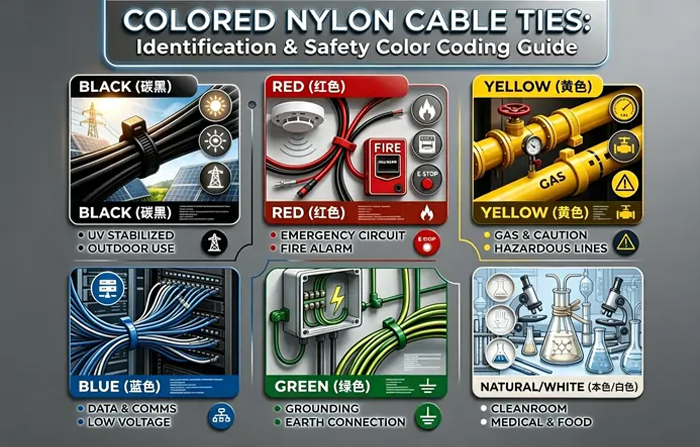
Industry-Specific Color Applications
Different sectors have developed their own color conventions based on their unique operational requirements:
Electrical and panel building. Control panel wiring uses color to distinguish voltage levels and signal types. A panel builder might use red ties on 480V feeders, blue ties on 24V DC control circuits, and black ties on general wiring. This simple visual system reduces the risk of a technician accidentally probing a high-voltage conductor when intending to test a low-voltage signal.
Automotive assembly. Vehicle wiring harnesses contain hundreds of individual wires routed through confined spaces. Colored ties help assembly line workers verify that the correct harness has been installed at each station. A specific color sequence may also indicate the shift or operator that assembled a particular harness, providing traceability for quality control.
Data centers and telecommunications. Server rack cabling benefits enormously from color coding. A data center team might assign blue ties to WAN connections, yellow to LAN, red to storage area networks, and green to management interfaces. When a network issue occurs, technicians can trace the affected circuit class without deciphering individual cable labels in a congested rack.
Medical and laboratory. In hospital settings, medical gas lines follow a legally mandated color code: white for oxygen, black for vacuum, blue for nitrous oxide, and yellow for medical air. The cable ties used on these lines must match the pipe color code so that the identification remains visible even if the pipe label is obscured.
For facilities specifying color-coded identification systems, colored cable ties provide a simple, durable way to implement visual identification without the cost and complexity of custom-printed labels.
UV Stability and Color: Outdoor vs. Indoor Use
The color of a cable tie affects its UV resistance because the pigments and additives used to create different colors interact differently with sunlight.
UV-stabilized colors. Black ties offer the best outdoor durability because the carbon black pigment absorbs UV radiation and prevents it from penetrating into the nylon polymer. Dark colors generally provide better UV protection than light colors. For outdoor applications—solar farms, telecommunications towers, exterior building wiring—black or UV-stabilized dark-colored ties should be specified.
Colors requiring caution outdoors. White, natural, and pastel-colored ties contain fewer UV-blocking additives. When used outdoors without UV stabilization, these ties can become brittle and fail within months of exposure. Some manufacturers produce UV-stabilized versions of lighter colors specifically for outdoor applications where color coding is required but black is not acceptable.
Indoor applications. Any color performs well indoors where UV exposure is not a factor. The full color range—including bright colors like pink, purple, and orange—is available for indoor identification without concern about sunlight degradation.
Selecting the Right Color System
The most effective color coding system is one that is documented, consistent, and understood by everyone who interacts with the installation. A color chart posted near the main electrical room, a reference card included in maintenance binders, or a simple labeling convention all help ensure that the intended color meaning persists over time, even as personnel change.
When specifying colored ties, consider these practical questions:
-
Does the application require UV-stabilized colors for outdoor exposure?
-
Is there an existing industry or facility color standard that must be followed?
-
Will the color system be documented so that future technicians can interpret it correctly?
-
Are the chosen colors available from suppliers in the required sizes and tensile strengths?
For procurement teams building a color identification system, reviewing the available range of colored identification and marking ties provides a starting point for matching specific color, size, and performance requirements to the application.
Disclaimer
The color coding conventions described in this article represent common industry practices and general guidelines. Color meanings and coding requirements may vary by region, industry, facility, and applicable regulations. This article is provided for informational purposes only and does not constitute professional engineering, safety, or compliance advice. Always consult applicable local electrical codes, industry standards (such as IEC, NFPA, ANSI, or national equivalents), and facility-specific documentation before implementing a color identification system. Product specifications, including UV resistance and material properties, should be verified with the manufacturer for the specific application and operating environment.
NEXT:How Metal Detectable Nylon Cable Ties Improve Food Safety
Interested in cooperation or have questions?
-
 View MoreMiniature Nylon Cable Ties 18 LBS
-
 View MoreIntermediate Nylon Cable Ties 40 LBS
-
 View MoreStandard Nylon Cable Ties 50 LBS
-
View MoreHeavy Duty Nylon Cable Ties 120 175 250 LBS
-
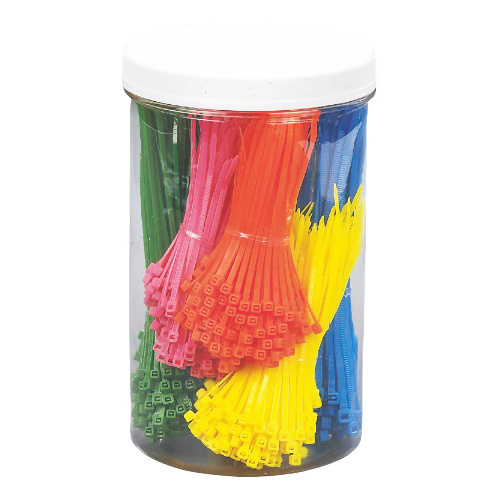 View MoreBulk Cable Tie Value Pack
-
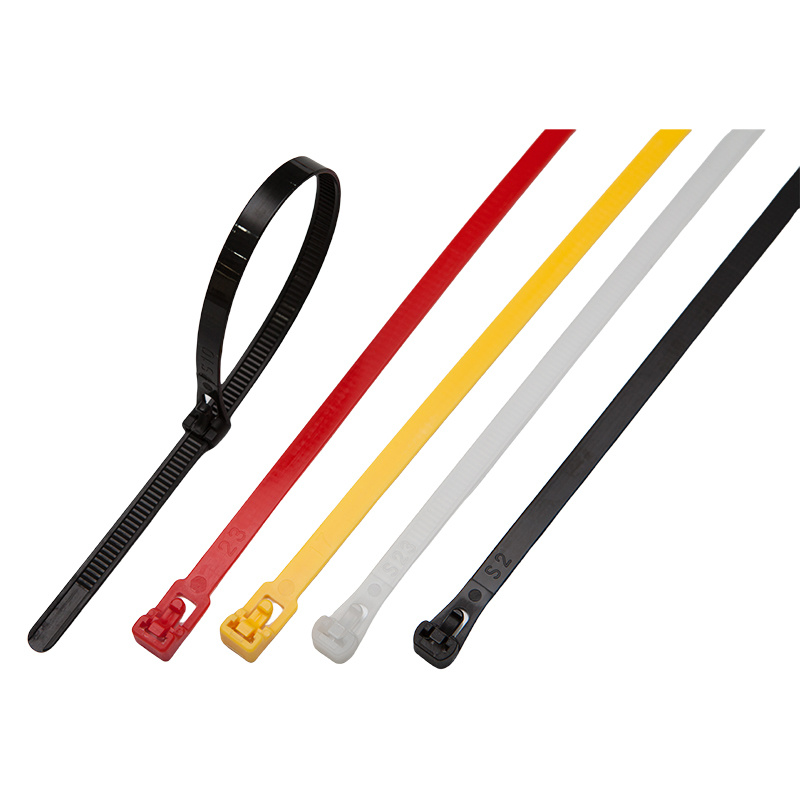 View MoreReusable Releasable Cable Ties
-
 View MoreMagic Reusable Cable Ties
-
 View MoreStainless Steel Self Locking Cable Ties
-
 View MorePVC Coated Stainless Steel Cable Ties
-
 View MoreMulti Lock Stainless Steel Cable Ties
-
 View MoreStainless Steel Hose Clamps
-
 View MoreStainless Steel Cable Tie Markers
 LET'S CREATE THE FUTURE TOGETHER

Contact Us Anytime
Our Location
No. 57, Yufang Road, Yangming Sub-district, Yuyao City, Ningbo City, Zhejiang Province, China.


Product Categories
Contact Us
bella@szsplastic.com
+86-15105741066
ivy@szsplastic.com
+86-15958801211
sabrina@szsplastic.com
+86-15205749066
vivian@szsplastic.com
+86-15158306808
allen@szsplastic.com
+86-15205748066
stella@szsplastic.com
+86-15990290008
dora@szsplastic.com
+86-15990281608
pepo@szsplastic.com
+86-15958801191
Copyright © NINGBO SANZHENG PLASTIC CO., LTD. All Rights
Reserved.
